Ready Before the Deadline Moves Again
The EUDR deadline has moved twice. MM Group kept building anyway. Twenty-one plants sit outside the automated compliance process by design, on systems already scheduled for replacement. Here's how a spreadsheet in a mailbox became a governed compliance pipeline, finished before the regulation was.
Austria (AT)
Paper & Packaging
4.1 B
13000+

21 plants
able to report from day one, across 27 locationsZero
interfaces built into systems scheduled for replacementWaiting
ready months before the 30 December 2026 obligationTable of contents
MM Group runs 60 production facilities across 30 countries. Its EUDR compliance reporting runs through an automated integration into the official EU system.
Twenty-one plants sit outside it, deliberately. Those sites run systems the group is already replacing as it moves onto a new architecture. Building bespoke EUDR interfaces into platforms with a decommissioning date would have meant paying to connect something scheduled for removal.
So the question was never how to integrate those twenty-one plants. It was how to make them compliant without integrating them at all.
Work started in June 2024, six months before EUDR was due to apply. The regulation has been amended twice since, and the obligation now lands on large operators on 30 December 2026. Neither postponement stopped the work.
A postponed regulation is still a regulation. Two amendments moved the date. Neither moved the obligation.
Challenge
Nothing was broken. That is what made this unusual.
EUDR reporting hadn't started. There was no queue, no backlog, no failing process to rescue. What existed was a gap with a date attached, and the gap was wider than a reporting line. The regulation reaches into purchasing, where the origin of fibre is established, into production, where inputs have to stay traceable, and into the customer-facing side, where buyers need statements they can rely on. Compliance data for one plant is assembled from all three.
Two options were on the table for those twenty-one sites. The group rejected both.
Integrate each legacy ERP. A separate build per platform, into systems that already have a replacement date. By the group's own estimate it would have cost at least two to three times more. It would have been discarded within a few years. And it would have drawn on the one team the migration depends on, because the people who would build those interfaces are the people moving the estate onto the new architecture.
Submit by hand. Compliance data keyed into the platform that feeds the EU system, row by row, every reporting cycle, across twenty-one plants. That means hiring, permanently, for data entry. It also means a process that keeps no record of itself: no status, no audit trail, no way to answer whether a plant's data actually went through beyond asking someone who might remember.
A process with no record of itself is a poor foundation for a legal obligation.
EUDR reporting is mandatory, with penalties attached, and the week it starts is not the time to discover that nobody can prove what was submitted.
Not building interfaces into systems scheduled for decommissioning was a deliberate architectural decision, not a constraint the project ran into. It kept the ERP team on the migration, and it left EUDR reporting to be solved on the estate as it stands today.
Which left one interface. The one every system already produces.
Solution
A spreadsheet.
Unfashionable, and already understood at all twenty-one sites with no project needed at their end. It also does not care which system produced the file, which is the property that mattered: when those plants move onto the new architecture, the EUDR path does not have to be rebuilt.
So the path was built from the mailbox forward.
XLS files arrive in a single monitored mailbox. Procurement, production, customer portal: the same three processes the regulation reaches into, arriving as three sets of spreadsheets. The integration picks them up and processes them row by row. Each row joins the automated EUDR process and produces its own compliance record through the same APIs the automated plants use. Past the point the file is opened, there is no semi-manual process. There is one process with two entry points.
The file is not the unit of work. The row is.
A file-level design gives two outcomes: the batch worked, or it didn't. A row-level design gives a count. How many rows processed, how many waiting, how many in error, and which ones.
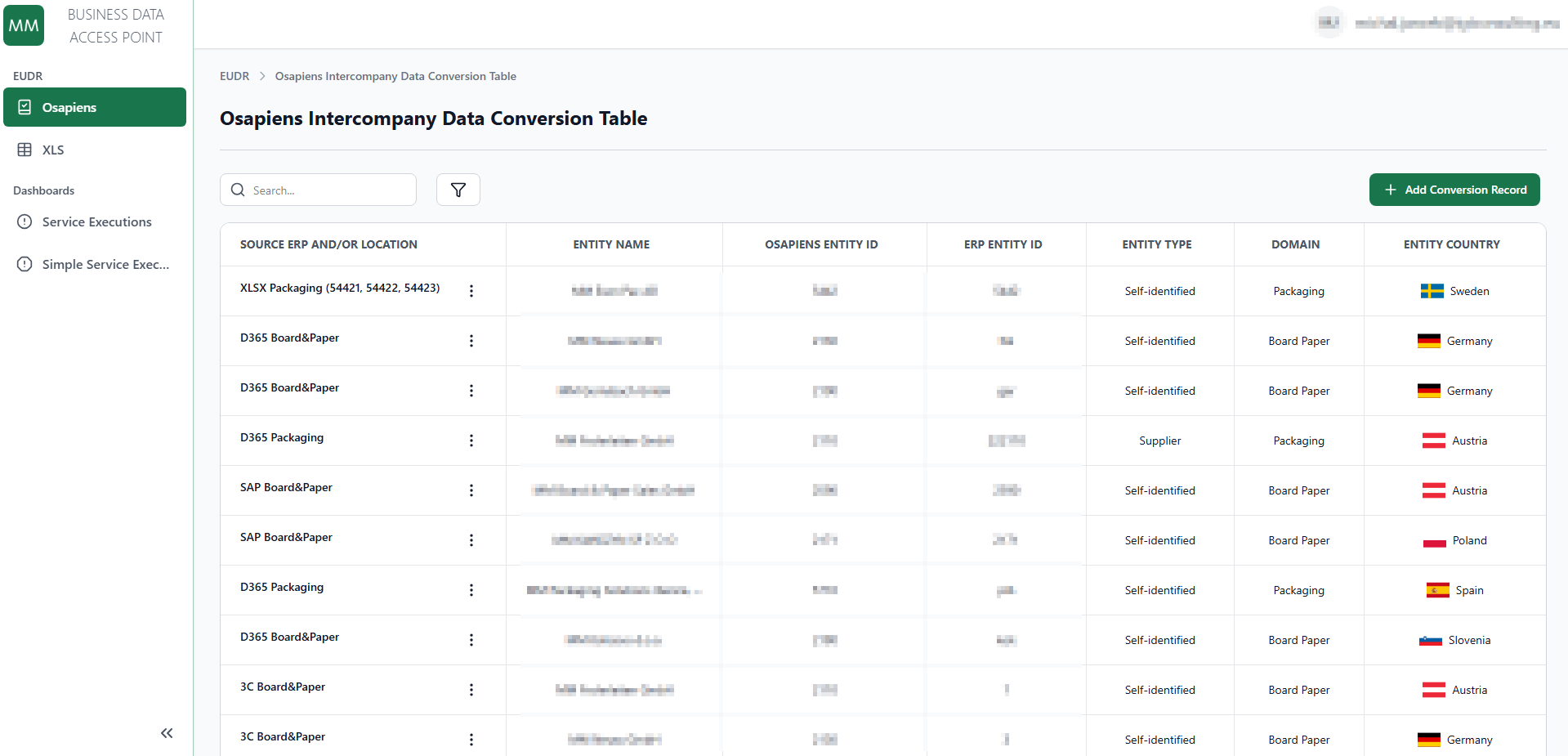
A daily dashboard reports exactly that, inside BDAP, the application IGT Systems built for the group across this programme. Every plant location receives a daily email with its own final status. Failures surface to a defined list of users rather than routing back to the site that sent the file. Plants send spreadsheets. They do not inherit an error queue.
Reprocessing was already in place from the automated phase and applies per record. A failed row is retried on its own.
Delivery Approach
The dates are the argument.
Feasibility started June 2024. That December the EU amended the regulation and moved the date to December 2025. The XLS build started September 2025. That December the EU amended it again and moved the date to December 2026. The system has been finished and waiting since spring 2026.
Two postponements landed inside this project, one before the build and one during it. Each was a defensible reason to pause. Neither stopped the work here, and neither forced a redesign.
On 30 December 2026, those twenty-one plants will have been ready for most of a year.
It was also two disciplines, neither subcontracted. BDAP did not exist when the programme started; it was built during it, on the group's own infrastructure, by the same team that built the pipeline reporting into it. The integration moves the data. The application makes the movement visible, and visibility is most of the value here, because a compliance process nobody can inspect is only marginally better than no process at all.
Stack and technical info
- Integration platform: webMethods
- Application platform: BDAP, built for the group by IGT Systems
- Frontend and backend: TypeScript, Kotlin
- Database: PostgreSQL
- Deployment: On-premises
- Inbound: single monitored mailbox, XLS files from procurement, production and customer portal interfaces
- Outbound: 3 REST APIs to the official EU EUDR system, via a compliance platform provider
- Processing model: row-level, with per-record reprocessing
- Scope: 21 plants across 27 locations
Results
EUDR applies to large operators from 30 December 2026. The system was finished before that date, and before the one before it.
Twenty-one plants can report from day one. Without one interface built into a system that is being replaced.
Every row carries its own record. Logged, visible in the interface, and reprocessable, with the same handling as any automated submission.
Status is visible before it is final. Processed, pending, in error, with counts, per plant, per day.
The reporting layer is the group's to keep. BDAP was built, not bought, and runs on the group's own infrastructure. The submission path uses a third-party platform. The record of it does not.
There are no throughput figures in this case study, because there is no throughput yet. The first real numbers arrive with the regulation.
What the group has in the meantime is a compliance process that already works, for every plant, including the ones it is in the middle of replacing.
Let’s make it click!
Whether you're scaling a startup or streamlining a corporate ecosystem, we help teams launch faster and integrate smarter.

Eva Polcíková
Project Manager