What Is SAP BTP? A Practical Guide to SAP Business Technology Platform
Your SAP core is surrounded by systems SAP did not build. An MES, a warehouse platform, a CRM, a partner EDI setup, and interfaces that each made sense on the day they were written. This is what SAP BTP is, where it sits in that landscape, and when it is not the answer you need.

Last technically reviewed: 26/08/2026. Reviewed by Marek Juračka, CTO.

Table of contents
If you run IT in a manufacturing, logistics, retail or utilities business, your application landscape almost certainly did not arrive by design. There is an SAP core. There is an MES or a warehouse system that predates it. There is a CRM someone bought in 2019, a handful of SaaS tools, a partner EDI setup, and a layer of interfaces that each made sense on the day they were built.
SAP BTP, short for SAP Business Technology Platform, is SAP's technology layer for working around and between those systems. It is used to integrate applications, extend them, automate processes, build new applications, and apply data and AI capabilities across both SAP and non-SAP environments.
This guide explains what SAP BTP is, what it is not, and where it belongs in an enterprise architecture. It is written for the decision that actually gets made in practice, which is rarely "should we buy BTP" and almost always "which capabilities solve which problem, and how do they fit what we already run".
What is SAP BTP?
SAP Business Technology Platform (SAP BTP) is SAP's enterprise technology platform for integrating systems, extending applications, automating processes, developing business applications, and applying data and AI capabilities across SAP and non-SAP environments. It acts as a technology layer around core business applications such as SAP S/4HANA rather than replacing them.
What does SAP BTP actually do?
BTP is not a single piece of software you install. It is a set of capability areas delivered as cloud services, which you consume selectively depending on the problem in front of you. In many mature estates only a narrow slice is ever used, and the rest is never touched.
Capability area | What it helps enterprises do | Typical example |
Integration | Connect applications, data and processes across the estate | SAP to MES, SaaS or trading partners |
Application development | Build and extend enterprise applications without modifying the ERP core | Side-by-side extension apps |
Automation | Automate workflows and process steps that span systems | Approval and exception handling flows |
Data and analytics | Make enterprise data usable outside the system that created it | Cross-system reporting and planning |
AI | Build and operate AI-supported business capabilities | AI-assisted enterprise workflows |
Platform operations | Secure, govern and operate what you build on the platform | Identity, monitoring, lifecycle management |
SAP's own SAP BTP product page is the reference point for how these capability areas are currently described. You will still see BTP described in older material as having four or five fixed "pillars". Treat that as a marketing taxonomy from a particular moment rather than a stable architectural fact. SAP's own framing of these capability areas has shifted more than once, and it will shift again.
Where does SAP BTP fit in an enterprise IT landscape?
The clearest way to place BTP is to separate two things that often get discussed as if they were the same layer.
Your systems of record hold the business truth. SAP S/4HANA or SAP ECC, the MES on the shop floor, the warehouse management system, the CRM, the billing platform. These are where transactions live.
A technology and integration platform layer sits alongside them. It does not own business data. It connects, extends, orchestrates and governs. BTP is one option for that layer, and in an SAP-heavy estate it is often the most natural one.
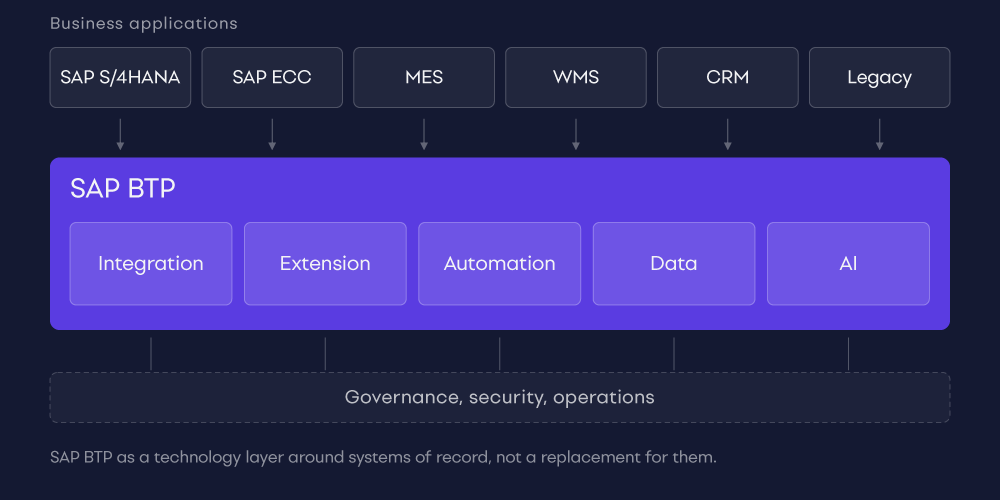
The distinction matters commercially, not just conceptually. Teams that treat BTP as "another SAP product to install" tend to buy first and find a use case later. Teams that treat it as an architecture layer start from the interfaces and extensions they already struggle to maintain, and the scope defines itself.
SAP BTP and SAP S/4HANA
They are not the same product and they do not compete. SAP S/4HANA is a core ERP application environment. SAP BTP provides technology capabilities that operate around and alongside it.
The practical consequence is architectural. Historically, when a business needed behaviour the ERP did not offer, that behaviour was built into the ERP through modifications, user exits and custom code. Every one of those decisions became an upgrade cost. BTP gives you somewhere else to put extensions and integrations so the core stays closer to standard. That principle now travels under the name Clean Core, covered further down.
SAP BTP and SAP Integration Suite
SAP BTP is the broader technology platform. SAP Integration Suite is the dedicated integration offering used within it to connect applications, APIs, data, events and business processes.
If your interest in BTP is integration, and for most enterprises with a mixed estate it is, then Integration Suite is the part of the platform you will actually spend your time in. The two are not competing choices and you do not need to decide between them. We cover the product itself in depth in SAP Integration Suite, and its internals in SAP Integration Suite architecture.
SAP BTP and the former SAP Cloud Platform
SAP Cloud Platform was the predecessor to today's SAP BTP positioning. Branding, portfolio structure and individual services all evolved over time rather than a single product being renamed once, which is why documents from different years describe the platform differently.
This matters mainly when you are reading older documentation, older SAP Notes or an architecture document written by a predecessor. If a 2019 design refers to SAP Cloud Platform, it is describing the ancestor of what you are looking at now, not a discontinued alternative.
How SAP BTP supports enterprise integration
Integration is where BTP earns its place in most heterogeneous estates, so it is worth being specific about what that covers:
SAP to SAP, for example S/4HANA to SAP Ariba or SuccessFactors
SAP to non-SAP, for example ERP to MES, WMS or CRM
Cloud to on-premise, where the ERP has not moved and will not move soon
API-based integration, exposing business capabilities in a governed way
Event-driven integration, where a system publishes a change rather than being polled
Partner and B2B integration across company boundaries
Hybrid architectures that span data centres, clouds and regions
The underlying argument for any governed integration layer is the same regardless of vendor. Point-to-point connections are cheaper on day one and more expensive every day after. Each new connection adds an edge to the graph, and the number of possible edges grows far faster than the number of systems. Eventually nobody can answer the question "what breaks if we change this field", and that is the point at which change slows to a crawl.
A governed layer does not eliminate that complexity. It centralises it somewhere it can be monitored, versioned, secured and reasoned about.
The arithmetic is unforgiving. A fully connected estate of ten systems has forty-five possible pairwise links; twenty systems have one hundred and ninety. Real estates never build every possible link, and they do not need to. They only need to build enough that no single person holds the whole map, and that threshold arrives earlier than teams expect.
SAP and non-SAP integration
Framing BTP as relevant only to all-SAP landscapes is the most common mistake in this topic, and it does not survive contact with a real manufacturing or logistics estate. The typical pattern is an SAP core surrounded by systems SAP did not build:
ERP to MES on the shop floor, often more than one MES across sites
ERP to warehouse and transport management
ERP to CRM, commonly Salesforce
ERP to cloud services and SaaS applications
ERP to logistics providers and carrier platforms
ERP to partner ecosystems over B2B and EDI
ERP to legacy applications nobody has budget to replace
This is not a theoretical list. Our own SAP and MES integration case study covers five factories, two different MES platforms and 41 integration points against a single SAP ECC core. That project was delivered on webMethods rather than on BTP, and we mention it here as evidence of what heterogeneous integration architecture involves at that scale, not as a BTP implementation.
The reason the distinction matters is that the hard problems in that project were not platform-specific. Deciding which system owns which master data, agreeing a canonical format that two MES platforms could both live with, and designing what happens when a plant goes offline mid-shift are architecture problems. The platform choice comes after.
Common enterprise use cases for SAP BTP
Use case | Why BTP may be relevant |
Connect SAP and non-SAP applications | Govern integration across a mixed landscape rather than accumulating point-to-point links |
Modernise legacy integrations | Move away from brittle or ageing middleware patterns |
Support S/4HANA transformation | Decouple appropriate integrations and extensions from the ERP core |
Build APIs | Standardise and secure access to business capabilities |
Introduce event-driven integration | Reduce unnecessary synchronous coupling between systems |
Extend SAP applications | Add side-by-side capabilities without modifying the core |
Automate business processes | Coordinate workflows that cross system boundaries |
Support hybrid architectures | Connect cloud and on-premise environments under one operating model |
SAP BTP and Clean Core
Clean Core is the principle of keeping the ERP core as close to standard as possible, so that upgrades stay routine rather than becoming projects.
The problem it addresses is familiar to anyone who has run an older SAP estate. Years of modifications, custom tables and code sitting inside the core mean every upgrade requires regression testing across changes nobody fully documented. The system becomes progressively harder to move, and the cost of staying current rises until it stops being paid.
BTP supports the alternative by giving extensions and integrations somewhere else to live. Behaviour that would once have been coded into the ERP is built as a side-by-side application, and system-to-system connections run through a managed integration layer instead of bespoke interfaces in the core.
Two honest caveats. Clean Core is a direction rather than a binary state, and almost no real estate is fully clean. And moving customisation out of the core does not delete it. It relocates it, which is a genuine improvement in upgradability but not a reduction in total surface area to maintain. We go deeper in SAP Clean Core integration.
Can SAP BTP replace SAP PI/PO or other middleware?
Sometimes, partly, and the question as usually asked is the wrong one.
"Can we replace product X with BTP" invites a yes or no answer about platforms. The question that actually determines cost and risk is asked one interface at a time: which of these should be migrated as they are, redesigned, replaced with an API or an event, retired because nothing consumes them any more, or left exactly where they are?
In many PI/PO estates a meaningful share of interfaces fall into those last two categories. Interfaces get built and outlive their purpose, and nobody removes them because removal carries risk and inertia does not. A migration that moves everything one-to-one carries all of that forward and pays to host it.
Answering it properly means working through the interface inventory and its real consumers, technical dependencies including adapters and mappings, the architecture patterns each interface implements, the testing burden, and who operates the result. That work is a migration assessment, and it is the difference between a scoped programme and an open-ended one.
There is also a timeline attached. SAP Process Orchestration runs on SAP NetWeaver, with mainstream maintenance published as ending in 2027 and optional extended maintenance running to 2030, per SAP's published maintenance strategy. That is not an emergency, but it is short enough that a large estate should be assessed rather than deferred.
A recurring pattern in that inventory is threefold. Interfaces built for a business process that has since changed or ended. Duplicated interfaces moving substantially the same data, built by different teams several years apart. And interfaces whose consuming system was decommissioned without anyone switching off the feed. None of these are worth migrating, and all of them are considerably cheaper to find before a migration than during one.
The full methodology is covered in SAP PI/PO migration to SAP Integration Suite.
What should enterprises consider before adopting SAP BTP?
BTP adoption should follow an architecture decision, not precede one. Before committing, work through:
Business use case. A named problem with an owner, not a platform strategy in search of one
Existing SAP landscape. ECC or S/4HANA, on-premise or cloud, and the roadmap for each
Existing middleware. What you run today, what it costs, and how much of it is load-bearing
SAP to non-SAP mix. The more non-SAP weight, the more the vendor-neutral argument deserves a hearing
Architecture standards. Whether you have agreed patterns, or whether every team invents its own
Security and identity. How identity propagates across the layer and who authorises what
Governance. Who approves a new interface, and what stops the estate sprawling again
Monitoring and operations. Who sees a failure at 02:00 and what they can do about it
Team capabilities. The skills you have now against the skills the target needs
Commercial model. How consumption maps to your actual volumes, modelled rather than assumed
Migration effort. Sized from an assessment, not from a vendor estimate
Operating model. Who owns the platform after go-live, and whether that team exists yet
The last one is the most commonly skipped and the most expensive to skip. A platform without a named owner degrades quietly.
When is SAP BTP a good fit?
The conditions that most consistently favour BTP:
An SAP-heavy landscape where the ERP is genuinely the centre of gravity
An active or planned S/4HANA transformation
A need for governed SAP to non-SAP integration rather than tactical connections
Legacy middleware approaching an end-of-maintenance date
Hybrid architecture spanning cloud and on-premise
API and event modernisation of older interface styles
A Clean Core initiative with executive backing
Extension requirements at enterprise scale rather than departmental scale
When might SAP BTP not be the only or best answer?
This section exists because the honest answer is not always BTP, and any consultancy that tells you otherwise is describing its own incentives.
Many enterprises already run an integration platform that works. MuleSoft, webMethods, Boomi, Azure Integration Services, or something built in-house. Those platforms have real strengths. webMethods is strong in B2B, EDI and managed file transfer, and in hybrid estates where a large on-premise footprint is not going anywhere. MuleSoft and Boomi bring mature API-led tooling and large connector ecosystems. Azure Integration Services is often the path of least resistance where the wider estate is already Microsoft.
Their common limitation against BTP is depth of SAP-specific content. SAP ships pre-built integration content, adapters and semantic knowledge of its own applications that third-party platforms replicate at additional effort. BTP's corresponding limitation is the mirror image. It is strongest where SAP is the gravitational centre and less compelling where SAP is one system among many.
Which points to architectures that are rarely discussed in vendor material:
Coexistence. Two platforms, deliberately, with a documented rule for what runs where
Gradual migration. New builds on the target platform while the incumbent runs down over years
Workload specialisation. SAP-centric flows on Integration Suite, B2B and file transfer where they already work well
Multi-platform by acquisition. Consolidation as a multi-year programme rather than a decision
The failure mode worth naming is the half-finished migration: two platforms, no rule about which is which, and double the operating cost. Coexistence is a legitimate architecture when it is chosen. It is expensive when it is merely what happened.
Where the boundary is drawn matters less than whether it can be stated in one sentence. Splitting by workload characteristic tends to hold: SAP-centric application integration on one platform, B2B, EDI and managed file transfer on whichever platform already handles them well. Splitting by project, or by whichever team moved first, tends not to hold, because the resulting rule cannot be explained to the next architect who joins.
Our view on the vendor-neutral side of this is set out in what integrates with webMethods and across our enterprise integration services.
How does SAP BTP relate to SAP Business AI Platform in 2026?
SAP BTP capabilities are now positioned by SAP as a core part of SAP Business AI Platform. SAP BTP has not been discontinued, and the underlying capabilities have not been withdrawn. What changed is the umbrella the portfolio is presented under.
This is worth stating plainly because the terminology shift has produced a predictable crop of confused questions. Is BTP being retired? Do we need to buy something different? Does an architecture document written last year still apply?
No, no, and yes. The SAP BTP name remains in active use across product pages, documentation, learning material and services. Integration Suite is still the integration offering within it. Cloud Foundry, Kyma and ABAP are still the environments. Nothing in a 2025 architecture decision becomes invalid because the portfolio above it was repositioned.
There is useful precedent for reading these changes calmly. SAP Cloud Platform evolved into SAP Business Technology Platform through a combination of rebranding and genuine portfolio restructuring, and organisations that treated it as a product replacement wasted effort that organisations treating it as a naming change did not.
The practical guidance is unchanged either way. Evaluate the capabilities you would actually use, on their current documented behaviour, and check SAP's own product pages for naming at the point you are writing an architecture document rather than relying on any article, including this one. Umbrella names move faster than adapters do.
What would genuinely change a plan is different: a capability deprecated, a runtime withdrawn, a maintenance date moved. Those appear in SAP's release notes and maintenance documentation rather than in portfolio announcements, and those are the pages worth monitoring.
How to start evaluating SAP BTP
A sequence that tends to produce decisions rather than workshops:
Map the current application and integration landscape, including the connections nobody documented
Identify concrete pain points with named owners and a rough cost
Inventory existing middleware and interfaces, including which are still consumed
Define target architecture principles before evaluating products against them
Identify candidate BTP use cases and test them against those principles
Assess security, governance, operations and commercial model together, not in sequence
Prioritise a pilot or first migration wave narrow enough to finish
Define measurable success criteria before starting
Steps one to three are where most of the value sits, and they are the steps most often skipped because they are unglamorous and produce no demo. They also happen to be the steps that determine whether the rest of the programme is scoped or open-ended.
Conclusion
SAP BTP is best understood as a technology platform rather than another SAP application. Its value is entirely dependent on the problem being solved, which is why "do we need BTP" is a question that resists a general answer.
For enterprises running heterogeneous estates, and in manufacturing, logistics, retail and utilities that is nearly all of them, integration and modernisation are where the platform tends to justify itself. An SAP core surrounded by systems SAP did not build is the normal case, not the difficult one.
The useful next question is narrower than the one most evaluations start with. Not "do we need BTP", but which capabilities, for which workloads, and how do they fit alongside what is already running and working.
If your landscape spans SAP and non-SAP systems and you are weighing modernisation against coexistence, our SAP integration services team works through exactly that assessment. No pitch, just the architecture conversation.
See also: What is SAP Integration Suite? · SAP PI/PO migration · What is webMethods?
Sources
• SAP: SAP Business Technology Platform product page
• SAP Help Portal: SAP Business Technology Platform documentation
• SAP: SAP Integration Suite product page
• SAP: Product maintenance strategy and Product Availability Matrix
Related questions
What does BTP stand for in SAP?
What is SAP BTP used for?
Is SAP BTP the same as SAP S/4HANA?
Is SAP Integration Suite part of SAP BTP?
Can SAP BTP integrate non-SAP applications?
Does SAP BTP replace SAP PI/PO?
What is the difference between SAP BTP and SAP Cloud Platform?
Is SAP BTP the same as SAP Business AI Platform?
Does every SAP customer need SAP BTP?
When should an enterprise use SAP BTP?
Latest writings
The latest news, technologies, and resources from our team.
View all blogs


Let’s make it click!
Whether you're scaling a startup or streamlining a corporate ecosystem, we help teams launch faster and integrate smarter.

Eva Polcíková
Project Manager