SAP Clean Core Integration: Released APIs, Events and What to Do With the Interfaces Already in Your Core
Interfaces are where many SAP cores quietly get dirty. What Clean Core asks of integration, how SAP's new integration levels rate IDoc, BAPI, APIs and events, what to do with custom interfaces already in the core, and the limits worth stating.

Last technically reviewed: 03/11/2026. Reviewed by Marek Juračka, CTO.

Table of contents
Clean Core is the principle of keeping the ERP core close enough to standard that upgrades stay routine. As we set out in our guide to SAP BTP, it is a direction rather than a binary state, and moving customisation out of the core relocates it rather than deleting it. This article covers the part that guide left open: SAP clean core integration, meaning what Clean Core asks of the interfaces between SAP S/4HANA and everything connected to it.
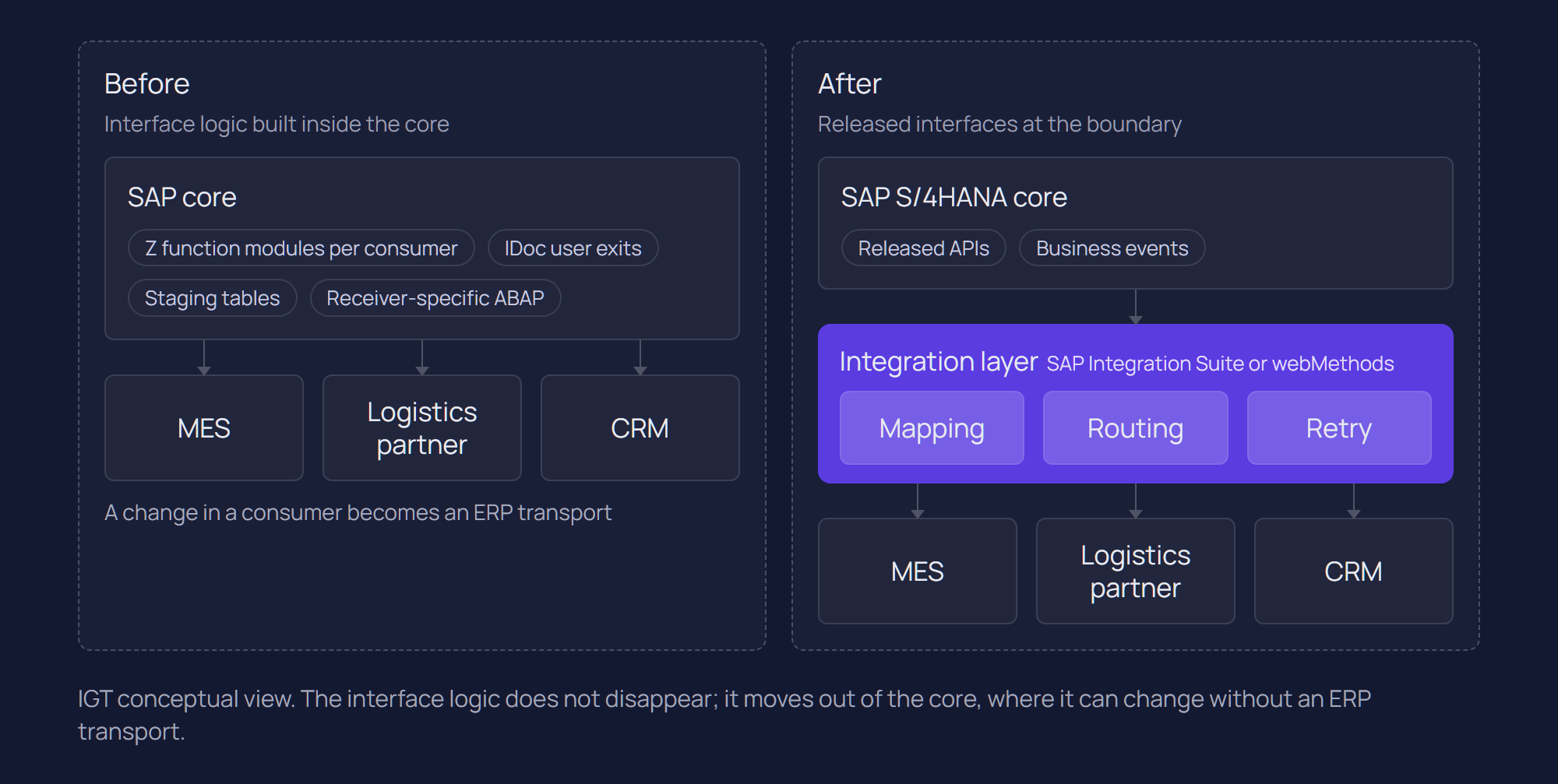
Interfaces deserve separate treatment because they are where many cores quietly accumulate custom code. A Z function module written for one MES, an IDoc extension added for a logistics partner, a staging table that exists only to assemble outbound data: each made sense when it was built, and each is now part of every upgrade.
Below: how SAP now classifies integration technologies, what SAP BTP contributes, what to do with the interfaces you already run, and how this applies when much of the estate is not SAP.
In short
Clean Core integration means the core communicates through released, stable interfaces (APIs and events) while mapping, routing and orchestration live in an integration layer outside it.
SAP now rates integration technologies on an A–D scale in SAP Note 3690029, separate from the extensibility levels in SAP Note 3578329, so "is this interface clean?" has a documented answer.
Existing custom interfaces are a portfolio to classify (keep, replace, retire), not a backlog to rewrite, and the integration layer does not have to be SAP's.
What does Clean Core mean for integration?
For integration, Clean Core means the ERP core exposes and consumes only stable, documented interfaces, and the logic that adapts data for a particular system or partner sits outside the core. SAP's training material frames it as a shift away from fragile custom integrations inside the ERP, towards a core that communicates through standard APIs and events (SAP Learning: making integrations clean core compliant).
SAP also separates two questions. Extensibility asks how S/4HANA itself is extended, for example with a BAdI. Integration asks how S/4HANA is accessed from another system, for example through an OData service, an IDoc or a BAPI. An IDoc interface with a custom IDoc extension is both.
Why are interfaces where cores get dirty?
Because for many years the fastest way to connect a system to SAP was to build the connection inside SAP. The results look similar across many mature SAP estates:
Custom IDoc extensions, with user exits filling extra segments for one receiver.
Remote-enabled Z function modules written for a single consumer, often reading SAP tables directly.
Receiver-specific ABAP: code-list translation, file formatting, retries and scheduling for one downstream system.
Staging tables and custom reports that assemble outbound payloads before any middleware sees them.
Each of these couples the core to a consumer. When the MES changes a field, the change becomes an ERP transport. When SAP changes an internal object the interface reads, it breaks at upgrade. And because the code is spread across exits and jobs, a custom code analysis may flag it without anyone recognising it as an interface.
How does SAP classify clean integration in 2026?
SAP uses an A–D clean core level concept, introduced for extensibility in August 2025 and applied to integration technologies through SAP Note 3690029 in 2026. The two scales look alike but answer different questions.
The clean core extensibility levels
In August 2025 SAP replaced its earlier 3-tier extensibility model with four levels, set out in a new clean core extensibility white paper and SAP Note 3578329, and summarised in SAP's announcement:
Level A: only released, stable SAP interfaces and extension points. ABAP Cloud and side-by-side extensions on SAP BTP belong here.
Level B: also uses SAP's classic APIs, which are documented and generally upgrade-stable. A BAPI is a typical example.
Level C: accesses SAP internal objects, with no stability guarantee. SAP provides a changelog to help manage the risk.
Level D: not recommended techniques such as modifications, write access to SAP tables and implicit enhancements.
An extension is rated by the lowest-ranked technology it uses (SAP Learning: clean core extensibility). The Cloudification Repository shows how individual SAP objects are classified, and the ABAP test cockpit now has checks for the level concept (SAP Community: ABAP Platform 2025).
The clean core integration levels
SAP published a dedicated integration note because the extensibility note was being applied to interface questions it was not written for. SAP Note 3690029 rates interface technologies, protocols and patterns on the same A–D scale, using two criteria: support in SAP S/4HANA Cloud Public Edition, and alignment with modern standards such as event-driven architecture and an API-managed strategy.
Level | Meaning for an integration technology (SAP's summary) |
A | Strategic, cloud-ready and modern. The first choice. |
B | Works today, but plan to move on. |
C | Legacy with no cloud migration path. Only for clearly bounded on-premise scenarios. |
D | Avoid in any new design. |
The rules: stay clean by choosing the highest level available, and get clean by planning the move to the next level up. SAP's decision path starts with whether a released API or event on the SAP Business Accelerator Hub, or a standard SAP integration scenario, covers the requirement. A custom interface is the last resort.
Three details matter. Upgrade stability is deliberately not part of the integration rating, so check it separately. The July 2026 update added data integration and clarified that Clean Core and the SAP API Policy are separate dimensions, both to be assessed. And each technology's rating lives in the note itself, so look it up there rather than in summaries, including this one.
What are the principles of Clean Core integration?
Five principles follow from SAP's guidance. The grouping is IGT's; the substance is SAP's.
Standard content first. Check the SAP Business Accelerator Hub for a standard integration, released API or business event before designing anything. Where none exists, SAP's guidance is to raise the gap with SAP as a requirement.
Released interfaces at the boundary. The contract between the core and the outside world is a released API or event, not an internal table or a Z function module that happens to work.
Logic outside the core. Receiver-specific mapping, routing, enrichment and retry belong in the integration layer, where they can change without an ERP transport.
Use interfaces according to their character. SAP warns against using transactional interfaces for mass replication. Bulk data is a different pattern, covered in SAP integration patterns.
Govern continuously. SAP recommends "get clean, stay clean" processes and an interface repository, so the next urgent requirement does not rebuild what the last project removed.
How does SAP BTP support Clean Core integration?
SAP BTP provides the place outside the core where integration logic and extensions can run: SAP Integration Suite as the integration layer, event brokers for S/4HANA business events, and side-by-side extensions. None of it is mandatory for Clean Core, but in an SAP-centric estate it is often the most direct route.
Integration Suite as the integration layer
In SAP Integration Suite, Cloud Integration runs the mapping, routing and orchestration that would otherwise sit in ABAP, and API Management governs how APIs are exposed to consumers. Integration Suite is provisioned on SAP BTP, and supported workloads can also run in a private landscape through Edge Integration Cell.
For estates leaving SAP PI/PO, Migration Assessment now includes clean core modernisation recommendations (for IDocs since Q2 2025, for BAPIs since Q3 2025). The report suggests released APIs and business events that could replace the IDoc or BAPI behind an existing interface (SAP Community: modernising RFC/BAPI-based integrations). Whether the suggested API covers the business requirement is still a functional design decision.
Business events from S/4HANA
S/4HANA publishes standard business events, and SAP states that all business events it supports are published on the SAP Business Accelerator Hub (SAP Architecture Center: event-driven applications). Event Mesh suits starter and smaller-volume scenarios; SAP Integration Suite, advanced event mesh suits larger, distributed SAP and non-SAP event landscapes. For custom events SAP points to RAP, or to SAP Application Interface Framework on older releases and SAP ECC.
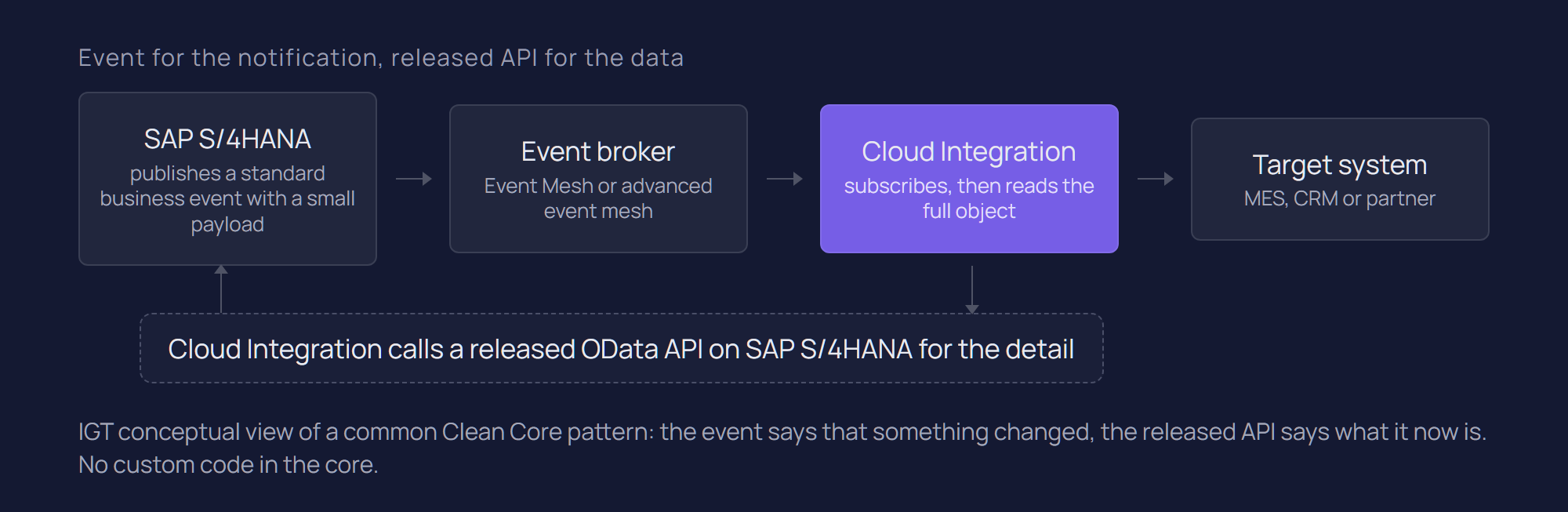
Standard events often carry a small payload, such as the object key, and the consumer calls a released API for detail. SAP's own example replaces an outbound address IDoc with a Business Partner change event plus an OData call, orchestrated in Cloud Integration (SAP Community: IDoc to events and APIs).
Side-by-side and on-stack extensions
SAP positions ABAP Cloud for both on-stack and side-by-side development, both Level A when built on released APIs. In our view, on-stack fits logic bound to a core transaction; side-by-side on SAP BTP fits logic that serves several systems.
IDoc, RFC, APIs and events through a Clean Core lens
No interface technology is clean or dirty by name. What matters is whether the specific interface is released, how SAP Note 3690029 rates the technology, and whether it suits the job. SAP's direction is released APIs and events first.
On IDocs, SAP recommends events and APIs for modern designs, while Cloud Integration still supports IDocs through a native adapter and SAP notes they still make sense in scenarios such as EDI with external partners. On RFC and BAPI, SAP describes three paths: lift and shift with the RFC adapter, replacing the BAPI with a released API, or exposing the same function as a SOAP web service. The last improves interoperability but leaves customer-managed objects behind, so it is a transitional step rather than an end state.
The table is IGT's reading of SAP's guidance. Check each technology's current level in SAP Note 3690029 before recording a decision.
Interface type | Clean Core position | Where it remains reasonable |
Released OData or SOAP API | Preferred where one covers the requirement | Request and response, create and update |
Standard business event | Preferred for decoupled change notification | Several consumers; pair with an API for detail |
Standard IDoc | Supported; APIs and events recommended for new designs | Partner EDI, stable existing flows, ECC cores |
IDoc with custom extension | Also governed by extensibility rules (SAP Note 3578329) | No standard alternative; keep the extension minimal |
Standard BAPI over RFC | Classic API; modernise where a released API exists | Interim phases, ECC, no equivalent released API |
Custom Z RFC function module | Custom code in the core; last resort | Genuine gaps, built to extensibility guidelines |
What should you do with existing custom interfaces?
Treat them as a portfolio: inventory every interface that touches the core, give each a disposition, and act in waves tied to changes already happening. Rewriting everything is as costly a mistake as rewriting nothing.
It is the approach we describe for SAP PI/PO migration, applied to the core boundary instead of the middleware. The cleanest outcome is often the least glamorous: retiring an interface nobody consumes removes its core footprint entirely.
Disposition | When it fits | Effect on the core |
Retire | No traffic, no owner, or the consumer has gone | Custom code and configuration removed |
Keep as is | Standard technology, stable, rarely changes | None; document and rate it |
Keep, move logic out | Standard interface wrapped in receiver-specific ABAP | Mapping and routing move to the integration layer |
Replace with released API | A released API covers the function | Custom or classic dependency removed |
Replace with event plus API | Change notification to several consumers | Consumers decoupled from the core |
Consolidate | Several interfaces move substantially the same data | Fewer objects to maintain and upgrade |
Timing matters too. An S/4HANA conversion, a PI/PO migration or a replaced consumer forces a test cycle anyway; modernising then avoids testing the interface twice.
Clean Core in a heterogeneous landscape
Clean Core constrains the boundary of the SAP core, not the choice of integration platform. The principles hold whether the integration layer is SAP Integration Suite, webMethods or another platform: the core exposes released interfaces, and the layer owns the logic specific to each consumer.
MES integration shows why. Plants need plant-specific behaviour, and the historic temptation was to encode those variants in the ERP. Our SAP ECC and MES case study took the opposite route: webMethods Integration Server consumes SAP IDocs, transforms them into a canonical XML model and routes them to TRAKSYS or PREACTOR by plant configuration, across five factories and 41 integration points with zero code forks. It was an ECC project, not a Clean Core programme, but it has the property Clean Core asks for: plant-specific behaviour lives in the integration layer, not in the ERP.
If webMethods or another platform already handles B2B, EDI and managed file transfer well, Clean Core alone is no reason to move that traffic. Integration Suite's SAP-specific content and modernisation recommendations weigh most in SAP-centric flows. Deliberate coexistence is a legitimate architecture; more in what integrates with webMethods.
In IGT integration projects, a recurring pattern is that the hard questions are about ownership: which team owns a mapping once it leaves ABAP, and who approves a new interface at the core boundary.
The limits worth stating
Clean Core integration improves upgradability. It does not reduce total integration effort, and it has costs.
Relocation is not reduction. A mapping moved from ABAP to Cloud Integration still has to be maintained, tested and owned. The gain is that it no longer blocks an upgrade.
Direction, not state. Level B and C interfaces will remain in many estates for years. SAP's model is incremental by design.
The integration layer has a cost. Subscriptions, runtime, monitoring, skills and an operating model. A clean core next to an ungoverned integration layer has moved the problem, not solved it.
Released API coverage is uneven. Sometimes only a BAPI does the job. Choose the highest level available, document it, revisit.
The rules evolve. SAP updates its notes and reclassifies objects, so a rating recorded this year needs rechecking later.
Where to start
Start with an inventory of every interface that touches the core, including those built in ABAP rather than middleware, then prioritise where change is already planned. IGT recommends the following sequence; it is our framework, not an SAP standard.
Inventory the core boundary. IDoc partner profiles, remote-enabled function modules in use, web services and file jobs, each with its consumer and owner.
Rate each interface. The technology level from SAP Note 3690029, plus ATC results for any custom code behind it.
Classify. Retire, keep, move logic out, replace or consolidate.
Take the quick wins. Retire what is unused; replace where a released API or event exists and the interface is changing anyway.
Set the standard for new work. Record the chosen level and reasoning in every new interface design, as SAP recommends.
Govern. An interface repository and a review gate keep the boundary clean after the project ends.
Conclusion
Clean Core integration is about the boundary of the ERP: released APIs and events at the edge of the core, and integration logic in a layer that can change without an ERP transport. SAP has given that idea a concrete shape, with clean core levels for extensibility and, since 2026, for integration technologies.
The practical work is classification more than conversion: know what crosses the boundary, rate it, retire what nobody uses, and modernise when a change is already happening, whichever platform runs the integration layer.
If you are planning an S/4HANA programme or a PI/PO migration and want a clear view of the interfaces at your core boundary, talk to our SAP integration team or see our SAP integration services.
Related questions
Does Clean Core mean no custom code at all?
No. SAP's clean core level concept rates extensions from A to D, and classic ABAP using classic APIs can still reach Level B. The aim is the highest level feasible for each requirement, with custom logic in the right place.
Can IDocs still be used in a Clean Core architecture?
Yes. IDocs remain supported, including through the IDoc adapter in Cloud Integration, and SAP acknowledges scenarios such as partner EDI where they still make sense. For new designs SAP recommends released APIs and events, so check the current rating in SAP Note 3690029 and treat custom IDoc extensions as an extensibility question too.
Is SAP BTP required for a Clean Core strategy?
Not strictly. On-stack ABAP Cloud development is also Level A, and another platform can host the integration layer. BTP provides side-by-side extensions, event brokers and Integration Suite, which makes it a natural choice in SAP-centric estates.
How does Clean Core affect a PI/PO migration?
It makes the migration a chance to modernise selected interfaces rather than copy them. Migration Assessment now suggests released APIs and events for IDoc and BAPI scenarios, but each interface still needs its own disposition. See our PI/PO migration guide.
Sources
SAP News: Discover How to Extend SAP S/4HANA Cloud the Right Way
SAP: Clean core extensibility for SAP S/4HANA Cloud (white paper)
SAP Community: ABAP Platform in SAP S/4HANA Cloud Private Edition and SAP S/4HANA 2025
SAP Learning: Exploring Clean Core Extensibility Best Practices
SAP Learning: Exploring How to Make Integrations Clean Core Compliant
SAP Community: Modernizing RFC/BAPI-based Integrations for a Clean Core with SAP Integration Suite
SAP Architecture Center: Designing Event-Driven Applications on SAP BTP
Latest writings
The latest news, technologies, and resources from our team.
View all blogs


Let’s make it click!
Whether you're scaling a startup or streamlining a corporate ecosystem, we help teams launch faster and integrate smarter.

Eva Polcíková
Project Manager