SAP API Management: Architecture, Policies, Governance, and When You Need It
Cloud Integration builds the interface. API Management decides who may call it, how often and in which version. Classic proxies versus the new API artifacts, the policies that matter, Developer Hub, and the cases where an API layer only adds a hop.

Last technically reviewed: 03/11/2026. Reviewed by Marek Juračka, CTO.

Table of contents
A familiar situation in SAP estates: S/4HANA holds order and delivery data, and three parties want it. A supplier portal needs order status, a field service app needs the same data on a phone, and an internal analytics team wants it too. Each opens its own path to the backend, with its own credentials, throttling and monitoring. When the backend changes, all three break, and nobody can say who is calling what.
SAP API Management is the capability in SAP Integration Suite built for that problem. It does not move or transform data between systems the way an integration flow does. It puts a governed, versioned, policy-enforced contract in front of a backend capability, so consumers depend on the contract rather than on the system behind it.
This article covers the building blocks as SAP names them in 2026, the policies that carry most of the weight, how API Management works with Cloud Integration, lifecycle governance, typical use cases, when you do not need it, and how it sits alongside other API platforms.
In short
SAP API Management governs how a capability is exposed (security, traffic, versioning, discovery and analytics), while Cloud Integration builds and transforms the integration behind it.
In 2026 SAP documents two models: Classic API Management with API proxies, and API-centric integration with API artifacts running on Integration Cell or a customer-managed Edge Integration Cell.
It pays off when one capability serves several consumers or crosses a trust boundary, and adds little to a scheduled file interface or a single internal call.
What is SAP API Management?
SAP API Management is the API Management capability of SAP Integration Suite. SAP describes it as a foundation to design, publish, govern and monitor APIs across cloud, private cloud and on-premise landscapes, in front of SAP and non-SAP backends.
It is not a separate product bolted on. In the list of Integration Suite capabilities, SAP groups it with Cloud Integration under "Integrations and APIs", and it is activated from the Integration Suite home page. Developer Hub, the consumer-facing catalogue, is documented as one of its sub-capabilities. For the wider capability set, see what SAP Integration Suite is.
The more important 2026 detail is that SAP's API Management documentation now describes two working models:
Aspect | Classic API Management | API-centric integration |
Design element | API proxy | API artifact (and MCP server artifact) |
Runtime | SAP-managed classic API Management runtime | Integration Cell (SAP-managed) or Edge Integration Cell (customer-managed) |
Integration logic | Outside the API layer, in the backend or Cloud Integration | Can sit inside the artifact: transformation, aggregation, orchestration |
Natural fit | Governing existing services and integration flow endpoints | APIs needing light logic and policy in one model, or private execution |
Both share the consumer side: products, Developer Hub and analytics. Availability of the newer runtime depends on service plan and region, so check current SAP documentation for your tenant before designing around it.
The problem it solves: contracts, not implementations
API Management lets consumers depend on a published contract (endpoint, schema, version, security scheme and usage terms) instead of on the system that implements it. The backend can then change without every consumer changing with it.
The SAP Integration Suite architecture article sets out the core distinction: Cloud Integration is about how systems exchange and transform information, API Management about how reusable APIs are exposed, secured, governed and monitored.
Behind a stable contract, the backend can move from ECC to S/4HANA, a direct call can be replaced by an integration flow, or load can be spread across provider systems. The consumer's base path, authentication method and quota stay the same. There is a structural gain too: four consumer applications calling two backends directly means eight connections to secure and monitor; behind one API layer there are four subscriptions and two backend connections, and each rule has one place to live.
One caution: abstraction is designed, not automatic. A proxy that passes an ECC payload straight through, with technical field names and internal codes, still ties consumers to the implementation.
Core building blocks
The building blocks are API providers, API proxies or API artifacts, policies, products and applications, Developer Hub and analytics. SAP's components overview names the runtime, design time (API portal), Developer Hub, API Analytics and API Designer, and states that API Management works with SAP and non-SAP APIs and backends.
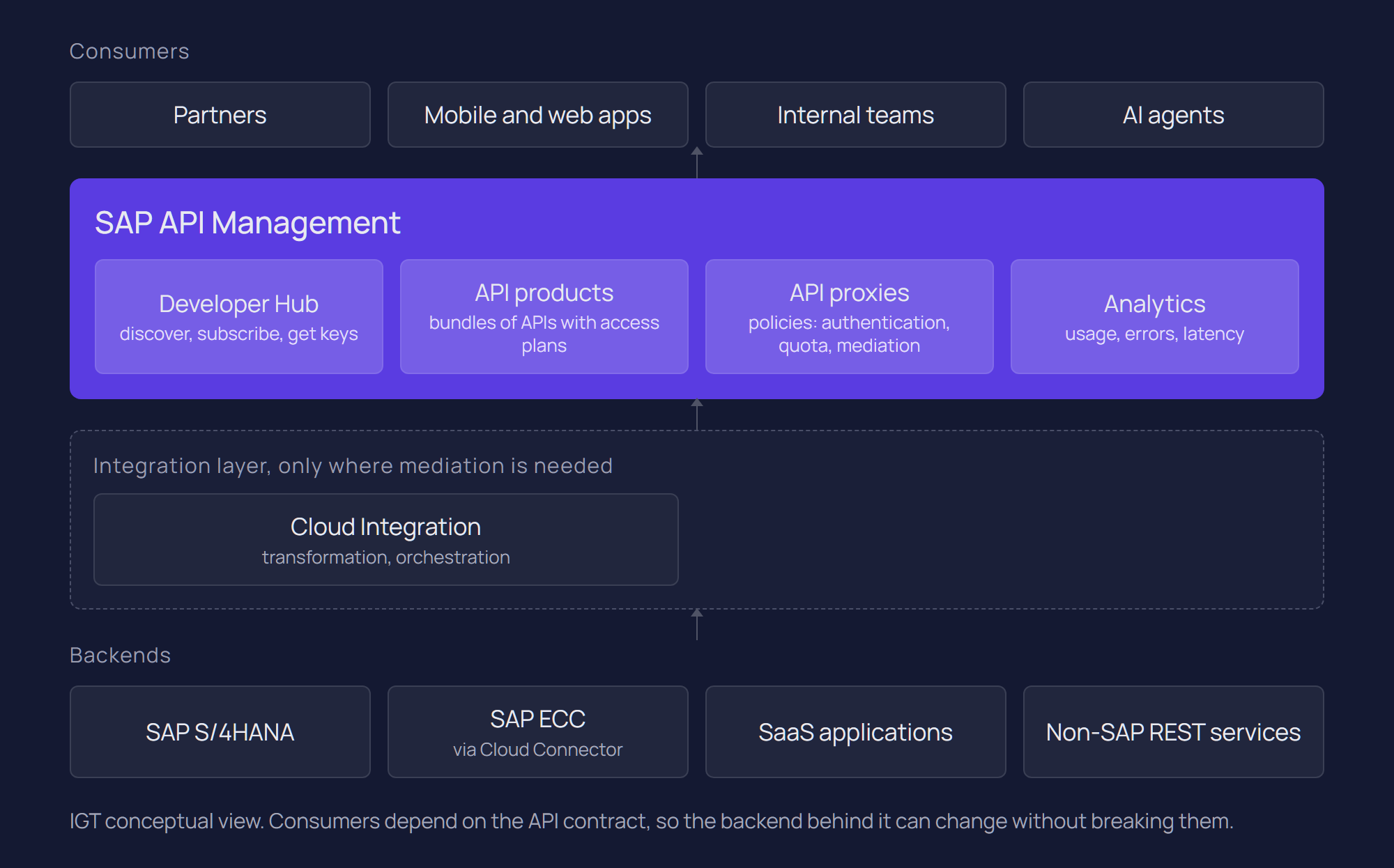
API providers, proxies and artifacts
An API provider holds the connection details of a backend: per SAP's concepts page, ABAP and SAP Gateway systems, generic REST hosts or third-party providers, over OData, REST or SOAP. On-premise backends are typically reached through SAP Cloud Connector. An API proxy is the object consumers call, mapping a public endpoint to a backend service and carrying the policies. In API-centric integration, the API artifact plays that role and can also hold integration steps. SAP additionally documents an MCP server artifact that exposes APIs to AI agents under the same governance, subject to service plan.
Products, applications and Developer Hub
A product bundles related APIs for an audience. A developer creates an application, selects products and receives an application key and secret. Developer Hub is where this happens: a catalogue of APIs, events and MCP servers where developers register, read documentation, subscribe and see their usage. Older material calls it the developer portal or API business hub enterprise.
Analytics, API Composition and externally managed APIs
API Analytics provides preconfigured dashboards on usage, performance and errors. API Composition, formerly called Graph, combines APIs from several systems into one unified API over business data graphs, exposed through OData v4 and GraphQL. Externally managed APIs let you import an OpenAPI 2.0 or 3.0 definition of an API run by another gateway and list it in Developer Hub, without a proxy or policies.
Policies that matter in practice
Policies are the rules an API enforces on every call, and they fall into three families: security, traffic management and mediation. Classic API Management offers more than 30 policy types, while API artifacts use a smaller policy model alongside integration steps.
Concern | Classic policy examples | API artifact policies | Practical note |
Identify the calling application | Verify API Key | Authentication | A key identifies an application, not a user |
Authenticate and authorise | OAuth v2.0, SAML Assertion, Basic Authentication | Authentication, Authorization | Decide early how user identity reaches the backend |
Reject malicious payloads | JSON Threat Protection, XML Threat Protection, Regular Expression Protection | JSON Threat Protection | Cheap to apply, often forgotten internally |
Enforce consumption terms | Quota | Quota | Per application: a contract term |
Protect backend capacity | Spike Arrest, Access Control | Surge Protection, IP Filter | Not client-specific: protects the system |
Adapt messages at the edge | Assign Message, JSON to XML, XSL Transform, JavaScript, Service Callout | Integration steps | Keep it light |
Security. An API key tells you which application is calling and drives its quota. It says nothing about the person behind it. If an S/4HANA authorisation check must run against the actual end user, the token flow from consumer through the API layer to the backend needs designing up front, including principal propagation through Cloud Connector for on-premise systems. API Management is one element of the security model, not the whole of it.
Traffic. Quota and Spike Arrest (Surge Protection on API artifacts) answer different questions. Quota limits how many calls an application may make over a period, which is a contractual term. Spike Arrest and Surge Protection smooth the overall request rate regardless of caller, to protect a backend with finite capacity. A busy ECC system often needs the second even when every consumer stays within the first.
Mediation. Header manipulation, JSON and XML conversion and small payload adjustments are reasonable at the API layer; multi-step orchestration is not. SAP's Classic API Management guidance keeps integration logic outside the API layer and recommends Cloud Integration for advanced scenarios. A proxy full of script callouts becomes an integration flow nobody monitors as one.
API Management and Cloud Integration together
Cloud Integration builds and transforms the integration; API Management governs how the result is exposed. Chaining them is one valid pattern rather than a rule, and SAP now also offers an option that combines both in one artifact.
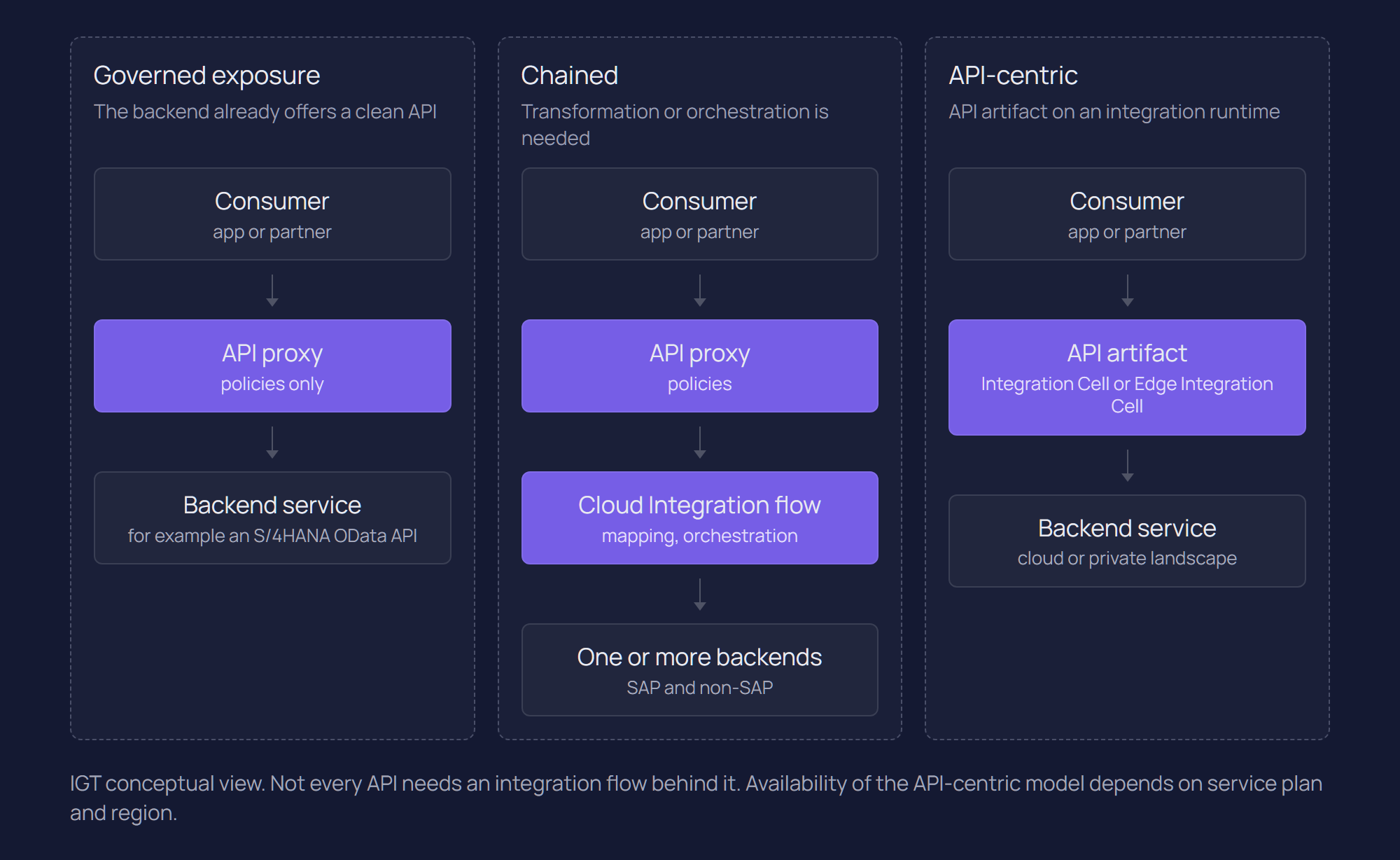
In practice, three shapes are worth evaluating:
Governed exposure only. The backend already offers a clean, stable service, such as a released S/4HANA OData API. A proxy adds security, quota, analytics and discovery with no integration flow behind it. Relying on released APIs also supports clean core integration.
Chained. Cloud Integration handles orchestration, mapping or protocol conversion, and an API proxy sits in front of the integration flow endpoint with authentication, rate limiting and logging.
API-centric. An API artifact on Integration Cell or Edge Integration Cell holds policy and light logic together, such as aggregating two backend calls. SAP's API-centric integration documentation positions it for this case.
The chained pattern costs an additional hop, two places to monitor and two artefacts to transport for one logical API. That is worth paying when the integration logic is substantial or reused by non-API consumers, and harder to justify when the flow only forwards a call, which is the case the API-centric model is designed to absorb. Heavy, long-running logic, or logic shared with file, event or B2B scenarios, still belongs in Cloud Integration. The wider choice is covered in SAP integration patterns.
Governance and API lifecycle
SAP API Management provides the lifecycle tooling (states, versions, products), but governance is a set of ownership decisions the tool cannot make for you. Without them, APIs become a newer form of integration sprawl.
States and versions. API proxies carry explicit states: Alpha, Beta, Active, Deprecated and Decommissioned. Versioning puts the version in the name and base path (for example /v1/SalesOrder), and versions can run side by side. Once a proxy is versioned, its version and base path cannot be edited, so the naming convention is worth agreeing first. API artifacts have their own versioning.
Deprecation that completes. SAP suggests a new version for incompatible changes, for policies consumers must adopt gradually, and for billing model changes. Retiring the old one is the harder part. IGT recommends a simple sequence: mark it Deprecated, announce a date through Developer Hub, use analytics to see which applications still call it, contact those owners, and decommission only when traffic has moved.
Ownership. Every API needs a business owner, who decides who may consume it and on what terms, and a technical owner, who answers for availability and change. In IGT's view, products are best cut by consumer audience (partners, mobile, internal analytics) rather than by backend system, because quotas, approval and documentation follow the audience.
Typical enterprise use cases
SAP API Management earns its place when one backend capability serves several consumers, or when a call crosses a trust boundary such as the company perimeter.
S/4HANA APIs for partners. Suppliers or logistics providers query order status, deliveries or invoices. Each partner gets an application, a scoped product, OAuth-based access and a quota, and the backend is never exposed directly.
Mobile and web applications. A field service app needs a small, stable API over several backend objects. Traffic policies protect the backend from bursts, and API Composition or an API artifact can shape the response into one call instead of four.
Internal reuse. Business units consume the same master data or pricing service. Developer Hub becomes the place to find what already exists, which reduces duplicate point-to-point builds.
Hybrid and agent access. Where data residency or latency argues for private execution, API artifacts can run on Edge Integration Cell while governance stays central. MCP server artifacts apply the same governed exposure to AI agents.
When you do not need SAP API Management
You do not need it when there is no API to govern, or no consumer that benefits from a contract layer. A policy hop in those cases adds latency and operational surface without architectural gain.
One consumer, one provider, internal and stable. An integration flow with its own authentication and monitoring often serves better.
Scheduled file or batch interfaces. A nightly file to a warehouse system has no API to govern; Cloud Integration or managed file transfer fits.
Calls inside an orchestration. When Cloud Integration calls a backend as one step, the flow already handles connectivity and credentials.
Events and bulk data. Change notifications point toward Event Mesh or SAP Integration Suite, advanced event mesh; large data movement toward data integration technology.
Some organisations route every API through the gateway as policy, for uniform auditing. That is legitimate when chosen deliberately, and less defensible as a default nobody remembers deciding. And if the real problem is that nobody knows which APIs exist, a catalogue in Developer Hub may be the first step rather than a proxy for everything.
SAP API Management alongside other API platforms
Many enterprises already run an API gateway, such as webMethods API Gateway, Apigee, MuleSoft or Azure API Management. The choice depends less on which product is better and more on where the backends live, which integration platform is strategic, and who will operate it.
IGT delivers SAP integration on Integration Suite and also delivers webMethods API Management, so we see both sides. Both cover the core: a gateway enforcing policies, a portal for discovery and subscription, and analytics. What decides the choice is mostly the estate around them.
Criterion | Points toward SAP API Management | Points toward an existing non-SAP platform |
Backend mix | Mostly SAP: S/4HANA, SAP SaaS, SAP BTP applications | Heterogeneous estate with a large non-SAP share |
Integration platform | SAP Integration Suite is the strategic integration layer | Another platform already runs integration, B2B and file transfer |
Runtime placement | SAP-managed cloud, or Edge Integration Cell, is acceptable | An existing on-premise or multi-cloud gateway already meets requirements |
Operations | SAP BTP skills and operating model in place | Established gateway team, tooling and support process |
Coexistence is common and can be sound, provided the boundary fits in one sentence, for example "SAP-originated APIs consumed by partners are governed in SAP API Management; everything else stays on the enterprise gateway". Externally managed APIs help: APIs governed elsewhere can still be listed in Developer Hub, so consumers get one catalogue across two gateways. Our SAP integration services cover architecture and delivery on Integration Suite, and we are equally comfortable recommending that an existing gateway stays.
Conclusion
SAP API Management turns backend capabilities into governed contracts that several consumers can rely on while the systems behind them change. It is not an integration engine, and not every interface needs it.
The 2026 picture adds a real design choice. Classic API proxies in front of backends and integration flows remain sound, API artifacts can remove a hop where the logic is light, and Edge Integration Cell brings the model into private landscapes. Choosing between them, and deciding who owns each API, matters more than any individual policy.
If you are planning an API layer for S/4HANA, or reviewing one that grew without governance, talk to our SAP integration team.
Related questions
Is SAP API Management part of SAP Integration Suite?
Yes. SAP lists API Management with Cloud Integration under "Integrations and APIs" in the Integration Suite capability set, activated from the Integration Suite home page, with Developer Hub as one of its sub-capabilities. Some older landscapes still run a standalone API Management subscription.
What is the difference between API Management and Cloud Integration?
Cloud Integration builds integrations: connectivity, transformation, routing and orchestration. API Management governs exposure: security, traffic limits, versioning, discovery and analytics. API-centric integration adds API artifacts that combine policy and light integration logic in one model.
Does every integration flow need API Management?
No. A scheduled file interface, an internal call with one consumer, or a backend call inside an orchestration has no API to govern. It is worth adding when a capability serves several consumers or crosses a trust boundary.
Can SAP API Management manage non-SAP APIs?
Yes. SAP documents support for SAP and non-SAP backends, including generic REST hosts and third-party providers, over OData, REST and SOAP. APIs governed by another gateway can also be listed in Developer Hub as externally managed APIs.
What is the API business hub enterprise called now?
Current SAP documentation calls the consumer-facing catalogue Developer Hub. It covers APIs, events and MCP servers, and is where developers register, subscribe to products and obtain credentials.
Sources
SAP Help Portal: API Management
SAP Help Portal: Capabilities of SAP Integration Suite
SAP Help Portal: Classic API Management
SAP Help Portal: API-Centric Integration
SAP Help Portal: Runtimes in API-Centric Integration
SAP Help Portal: Components of API Management
SAP Help Portal: Important Concepts of API Management
SAP Help Portal: Developer Hub
SAP Help Portal: Add Policies to Artifacts
SAP Help Portal: API Proxy States
SAP Help Portal: API Versioning
SAP Help Portal: Externally Managed APIs
Latest writings
The latest news, technologies, and resources from our team.
View all blogs


Let’s make it click!
Whether you're scaling a startup or streamlining a corporate ecosystem, we help teams launch faster and integrate smarter.

Eva Polcíková
Project Manager