SAP Integration Governance: A Practical Framework for Catalogue, Standards, Transports and Ownership
Migrations leave a tidy integration estate; governance keeps it that way. What to catalogue, how Integration Assessment and ISA-M settle technology choices, which naming, design and transport rules to fix early, who owns what, and a checklist to copy.

Last technically reviewed: 18/11/2026. Reviewed by Marek Juračka, CTO.

Table of contents
A PI/PO migration or an S/4HANA programme usually leaves a tidier integration estate than it found. A few years later, the same estate can look familiar again: duplicate flows for the same business object, packages named after finished projects, credentials nobody owns and interfaces nobody dares to switch off. SAP integration governance is what keeps the result of a migration from eroding once the project team moves on.
Governance here does not mean a committee or a thick standards document. It means a small set of rules, roles and tools that decide how each interface is requested, designed, approved, transported, operated and retired. SAP Integration Suite now ships several of these tools itself.
This guide sets out a practical framework for SAP BTP integration governance, from the interface catalogue to roles, and closes with a checklist you can copy. Where a topic is covered in depth elsewhere on this blog, we summarise it and link to it.
In short
SAP integration governance is the set of rules and roles that decide how interfaces are designed, approved, operated and retired, and it works only if each interface has a catalogue entry and a named owner.
SAP provides building blocks: ISA-M and Integration Assessment for technology decisions, published naming conventions and design guidelines for integration flows, and CTS+ or SAP Cloud Transport Management for controlled transports.
The framework, RACI and checklist in this article are IGT recommendations; scale them to the size of your team rather than copying a large-enterprise model.
What is SAP integration governance?
SAP integration governance is the set of rules and roles that decide how interfaces in an SAP landscape are designed, approved, built, operated and retired. For every interface it answers four questions: why it exists, how it is built, who owns it and when it goes away.
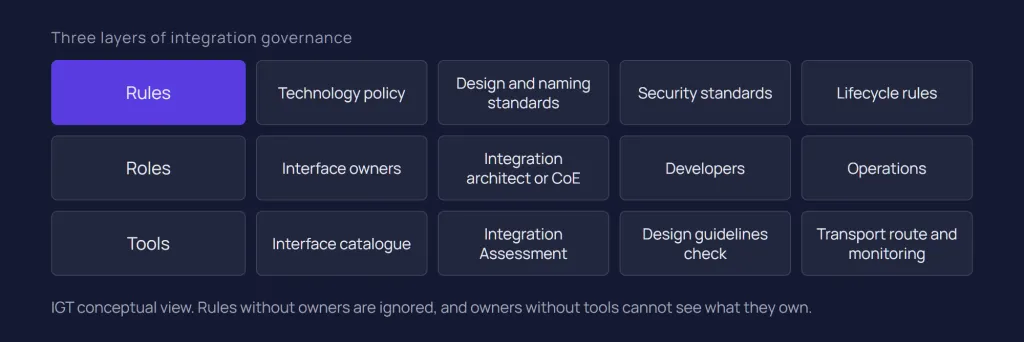
It sits between enterprise architecture and development. Architecture sets the target picture, for example that the S/4HANA core is reached only through released APIs and events, as described in Clean Core integration. Governance makes sure each new piece of work follows that picture without re-arguing it in every project. IGT describes it in three layers:
Rules. Technology policy, design and naming standards, security, logging and transport rules.
Roles. Business and technical owners, an integration architect or design authority, developers, operations and security.
Tools. An interface catalogue, Integration Assessment, design guideline checks, custom tags, access policies and a transport route.
Why integration estates drift
Integration estates drift because each project optimises for its own deadline, and nothing forces the next project to reuse what the last one built. Moving to the cloud does not change that; it only makes creating a new flow faster.
The causes are ordinary. A new project team starts in its own package. A second team needs the same business partner data and copies a flow because finding the first one takes longer. An urgent fix reaches production through a manual export. A contractor leaves, and their credential stays on the tenant with no owner.
The result is what IGT calls iFlow sprawl: point-to-point integration rebuilt inside the integration platform. A fully connected estate of 10 systems has 45 possible pairwise links, and an ungoverned integration layer can recreate all of them as separate flows. The anti-patterns behind this are covered in SAP integration patterns. A PI/PO migration is often the first time in years that every interface is inventoried and owned; without governance, that inventory starts ageing the day the project closes.
The interface catalogue and ownership
The interface catalogue is the single list of every interface in the landscape, with enough attributes to see who is affected by a change and who must act when something fails. Every other governance rule attaches to it.
IGT recommends recording at least:
Identity and endpoints. A unique interface ID, business name and process, sender and receiver (including non-SAP systems, partners and SaaS).
Pattern and technology. API, integration flow, event, file or replication, and the runtime: cloud, Edge Integration Cell or another platform.
Core boundary. The S/4HANA or ECC interface used (released API, event, IDoc, RFC) and its clean core level.
Owners. A business owner who decides whether the interface is still needed, and a technical owner who answers for its behaviour.
Operations and security. Criticality, alerting route, support group, reprocessing rule, authentication method, and credential and certificate names with expiry dates.
Lifecycle. Status (requested, in development, live, deprecated, retired) and artefact names on each tenant.
The two owners matter more than any attribute. A technical owner without a business owner keeps unused interfaces alive; a business owner without a technical owner cannot get an incident fixed.
Where the catalogue lives
No single SAP tool catalogues every interface type. The interface documentation chapter of SAP's PI/PO migration guide points to Interface Documentation in SAP Solution Manager 7.2, the interface fact sheet in SAP LeanIX for an enterprise-wide view, and OpenAPI specifications in API Management. The S/4HANA integration architecture article covers publishing S/4HANA Cloud APIs on the Developer Hub, which helps for APIs but not for IDoc and file interfaces.
Inside Cloud Integration, custom tags let a tenant administrator define mandatory package attributes with permitted values; saving a package fails when a mandatory tag is missing. IGT recommends tags for the interface ID and owner, so every package traces back to its catalogue entry.
Deciding how an interface is built
How an interface is built should follow an agreed technology policy, not the preference of whoever picks up the ticket. SAP's tool for this is Integration Assessment, a capability of SAP Integration Suite based on the SAP Integration Solution Advisory Methodology (ISA-M).
ISA-M works in two phases: describe integration requirements in technology-agnostic terms (integration domains, styles and use case patterns), then map them to the technologies that fit the organisation. The vocabulary is explained in SAP integration patterns, so we do not repeat it here.
What Integration Assessment does in 2026
SAP's documentation describes Integration Assessment as a way to assess an organisation's integration strategy in a structured way and determine the technologies that suit its requirements. Its main functions:
ISA-M settings. SAP delivers predefined master data, including SAP integration technologies and the key characteristics each supports. Organisations can adjust it and add their own technologies, including non-SAP platforms.
Integration policies. A policy combines an integration style, a domain, a recommendation degree (such as general recommendation or reasonable alternative), a rule text and optionally specific applications. Policies rank technologies for each context, which makes them the written technology guidelines.
Request-based assessment. A business domain expert creates a business solution request, and each needed interface becomes an interface request. A questionnaire captures the requirements, the system recommends a technology, and the interface request moves through Requirement Analysis, Technology Selection and Completed. A completed request can be downloaded as a PDF.
Landscape insight. An overview of the domains, styles, patterns and deployment models in use, plus discovery of standard SAP integration content.
In governance terms, the policy is written once and applied to each request, and every interface keeps a record of why it was built that way. SAP summarises the Integration Assessment process as "Define, document, and govern your integration technology strategy." It does not scan existing interfaces, and it is a different capability from Migration Assessment, which estimates the technical effort of moving PI/PO scenarios.
The review gate at the core boundary
The technology decision is half of the gate. The other half is the S/4HANA boundary: which released API or event the interface uses, and whether anything is built inside the core. IGT recommends that every request touching the core records the chosen interface and its clean core level, and that anything below the agreed level needs explicit approval from the integration architect. That turns SAP's "get clean, stay clean" idea into a process step.
Keep the gate proportionate. A new consumer of a documented API needs a catalogue entry and a security review, not a full assessment. New patterns, new system classes and core boundary exceptions are where the full review earns its time.
Design and naming standards
Design and naming standards make every integration flow readable by someone who did not build it. SAP publishes both naming conventions and integration flow design guidelines, and the guidelines can now be checked in the tenant.
Naming conventions
SAP's naming conventions for Cloud Integration are explicitly a recommendation that organisations can extend. They cover packages, integration flows, script collections, APIs, participants, channels and mappings, for example:
Packages: optional company prefix, business unit or the constant Global, scenario and optionally involved systems, such as XYZ_Global_CentralSourcing_Ariba. Reusable objects go into packages marked COMMON or similar.
Integration flows: business unit or Global, scenario and optionally sender and receiver, such as SubsidiaryA_PurchaseOrderReplication_S4_to_Ariba_US, up to 120 characters.
Channels: protocol, direction and operation, such as SOAP_SND_PurchaseOrderRead.
SAP advises generic system names rather than technical or environment-dependent ones, so names do not change between test and production. The SAP Cloud Integration article uses a shorter IGT pattern (source, target, business object, direction). Either works; what matters is choosing one before the first dozen flows exist.
Design guidelines as checks
SAP's integration flow design guidelines cover resilience, resource management, loose coupling, error handling, readability, security and prepackaged content, with reference flows on SAP Business Accelerator Hub. They are now also embedded in the tenant as design guidelines:
An integration lead enables all or a subset of guidelines, considering each one's severity. A dedicated role, WorkspaceDesignGuidelinesConfigure, can be assigned for this.
Developers execute the guidelines against an integration flow, API or script collection. A non-compliant guideline can be skipped only with a reason, and the downloadable report shows who skipped it.
The settings can be exported from one tenant and imported into another, keeping development tenants aligned.
SAP states that the guidelines do not disrupt the execution of artefacts, and its documented workflow has the integration lead review the report before go-live. They support a review step rather than replace it, and they check how a flow is built, not whether it should exist.
What to standardise
The table lists standards IGT recommends agreeing early. The example rules are ours to adapt, not SAP requirements.
Area | Example rule (IGT recommendation) |
Packages | One package per business scenario, not per project; mandatory tags for owner and interface ID |
Naming | SAP's convention or one documented alternative, generic system names only |
Configuration | Hosts, paths and credential names externalised, so one version moves unchanged between tenants |
Versioning | Major.minor.micro, a comment on every saved version, no drafts in production |
Reuse | Shared scripts and mappings in an owned COMMON package or script collection, no copies |
Error handling and logging | One exception subprocess template; Info level in production, trace time-boxed and approved |
Design checks | The same guideline set on all development tenants, report attached to each change |
APIs | Externally consumed APIs exposed through API Management with a standard policy set |
API products and policies are covered in SAP API Management, and capability boundaries in SAP Integration Suite architecture. SAP's Architecture Center reference architecture for API-managed integration, which builds on ISA-M, treats governed API consumption, with lifecycle and policy enforcement in one place, as part of the pattern.
Lifecycle: transport, versioning and retirement
Lifecycle governance decides how a change reaches production and how an interface leaves it. In Integration Suite the controls are the transport option, versioning rules and a defined retirement process.
Transport options
SAP documents four ways to move Cloud Integration content between tenants, and its decision help rates them:
Option | How it works | SAP's guidance |
SAP Cloud Transport Management | One-step transport through the BTP transport service | Recommended; automated, with roles, routes, approvals and logging; the choice where no on-premise CTS+ exists |
CTS+ | One-step transport through an on-premise CTS+ system, based on MTA archives | Recommended; a natural choice where CTS+ already serves other systems |
MTAR download | Download an archive and upload it manually to CTS+ or Cloud Transport Management | Exceptional cases, such as the connection to the transport system being down |
Manual export and import | Export from source and import into target by hand | Exceptional cases, such as urgent fixes when the transport system is down (SAP also lists it for first exploration of Cloud Integration); no control or logging of who transported what and when |
SAP's long-run good practice is cloud-related transports through Cloud Transport Management and on-premise transports through CTS+. The migration guide's transport management chapter adds that Cloud Transport Management is not planned to cover on-premise transports, and that the minimum landscape is two tiers, with three or four common in larger organisations. API Management artefacts can also be transported through Cloud Transport Management.
Some details matter for governance. Draft versions and artefacts protected by access policies cannot be transported, and externalised parameter values on the target are not overwritten on re-transport. Security material does not travel: SAP's page on handling artefacts across tenants says credentials, secure parameters and key pairs must be created on the target tenant, using the same names so references do not break. IGT recommends listing these per interface in the catalogue.
Versioning
Cloud Integration versions artefacts and packages with a major.minor.micro convention starting at 1.0.0, and SAP recommends combining it with a defined versioning policy. Version management is tenant-specific, so IGT recommends treating the development tenant version plus the transport record as the reference, and changing production only through the transport route.
Retirement
Retirement is where many governance models stop and sprawl starts. IGT recommends a simple sequence: the business owner confirms the interface is no longer needed, its catalogue status moves to deprecated, traffic is checked to confirm it has stopped, the flow is undeployed on each tenant, and its credentials, certificates and access policies are removed. Only then is the entry marked retired. Reviewing interfaces without traffic at an interval set by your own risk appetite keeps the list honest.
Security and operations standards
Security and operations standards decide who may call each interface, how it authenticates and who responds when it fails. They belong in governance because inconsistency between interfaces is where incidents start.
On security, IGT's minimum standard is a defined inbound authentication method per interface class, custom roles instead of the generic sending role, a named owner and expiry date for every certificate and credential, and access policies for packages with sensitive data. Details are in SAP Integration Suite security. Note that access policies also affect lifecycle: a package with a restricted artefact cannot be exported or deleted.
On operations, Cloud Integration is not delivered with out-of-the-box alerting, as the migration guide's monitoring chapter states; alerts are built with the SAP Alert Notification service, SAP Cloud ALM or another tool. The governance decision is where alerts go and who acts on them. Setup is covered in SAP Integration Suite monitoring, and retry design in SAP Integration Suite error handling.
Who governs: roles and an integration CoE
Someone must own the rules, and someone must own each interface. In a large enterprise that is often an integration centre of excellence (CoE); in a small team it can be one integration architect with a clear mandate. The roles matter more than the organisational form.
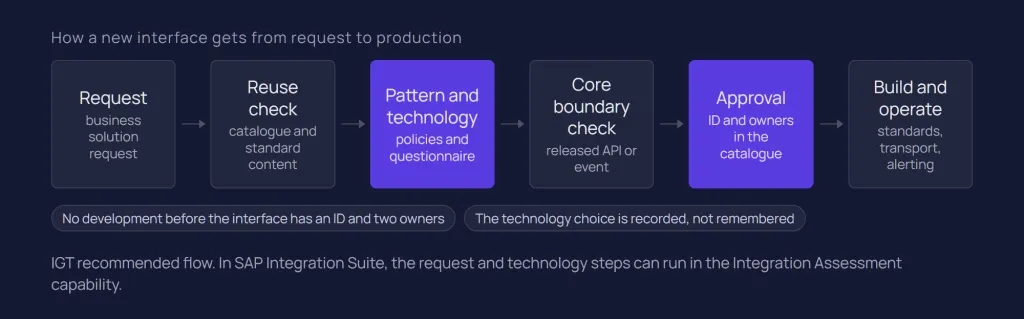
The decision flow for a new interface
IGT recommends a short, repeatable flow:
Request. The business need is raised, ideally as a business solution request in Integration Assessment.
Reuse check. Search the catalogue for an existing interface or API, and SAP Business Accelerator Hub for standard content.
Pattern and technology. The interface request goes through the questionnaire and policies; the outcome is recorded.
Core boundary check. For S/4HANA, confirm the released API or event and its clean core level.
Approval and catalogue entry. The interface gets an ID and owners before development starts.
Build, transport, operate. Development follows the standards, the design guideline report is attached, the change moves through the transport route, and operations accept the interface with alerting in place.
A RACI for integration governance
The RACI below is an IGT recommendation (R responsible, A accountable, C consulted, I informed). Adjust the role names to your organisation.
Activity | Business owner | Integration architect | Integration developer | Operations | Security and Basis |
Technology policy and standards | I | A, R | C | C | C |
Approve a new interface | C | A, R | C | I | C |
Catalogue entry and ownership | A | R | C | I | I |
Build to standards and design checks | I | A | R | I | C |
Transport to production | I | A | R | C | C |
Monitoring and first response | I | C | C | A, R | I |
Credential and certificate renewal | I | C | R | C | A |
Retire an interface | A | R | R | C | C |
Small team or large enterprise?
A small team does not need a CoE. It needs one person accountable for the standards, a current catalogue, a transport route and a regular look at new and unused interfaces. That person may be architect, reviewer and design guideline lead at once, as long as decisions are written down.
A large enterprise with several delivery teams and platforms usually benefits from a CoE or design authority that owns the technology policy, the standards and the Integration Assessment content, while delivery teams own their interfaces. Where SAP Integration Suite runs alongside webMethods or another platform, the CoE also owns the boundary between them, so one business object is not integrated twice; see SAP Integration Suite vs webMethods.
In either model, avoid a gate every change must queue for. If approval becomes a bottleneck, teams route around it and the catalogue stops reflecting reality. Delegate routine cases and reserve the review for new patterns and core boundary exceptions.
A governance checklist
This is IGT's working checklist. Copy it, remove what does not apply and assign an owner to each line.
One interface catalogue covers APIs, flows, events, IDoc, RFC and file interfaces, SAP and non-SAP.
Every interface has an ID, a business owner and a technical owner.
Mandatory custom tags link each Cloud Integration package to its catalogue entry.
Integration policies are maintained in Integration Assessment or an equivalent written technology policy.
New interfaces pass a reuse check and a recorded technology decision.
Interfaces touching the S/4HANA core record the released API or event and the clean core level.
One naming convention is documented and applied to packages, flows, channels, mappings and script collections.
An agreed design guideline set is enabled on every development tenant, with the report part of each change.
Environment-specific values are externalised; shared logic lives in owned, reusable packages.
Production changes use one transport route (Cloud Transport Management or CTS+); manual export and import is reserved for documented emergencies.
Security material needed on each tenant is listed per interface.
Every certificate and credential has an owner and an expiry date in the catalogue.
Every live interface has an alerting route, a support group and a reprocessing rule.
A retirement process exists, and interfaces without traffic are reviewed regularly.
Conclusion
SAP integration governance is less about documents than about a few decisions made once and applied every time: what is catalogued, who owns it, how the technology is chosen, which standards apply and how changes reach production. SAP Integration Suite now supplies much of the tooling, from Integration Assessment to design guidelines, custom tags and governed transports.
The organisational part remains yours, whether that is one accountable architect or a CoE. The goal is the same: the estate you have after a migration should still be understandable several projects later.
If you are setting up governance for SAP BTP integration, or a tenant has grown faster than its standards, our SAP integration services cover architecture, standards and delivery. Talk to our SAP integration team.
Related questions
What is integration governance in SAP?
It is the set of rules, roles and tools that decide how interfaces in an SAP landscape are requested, designed, approved, transported, operated and retired. It rests on an interface catalogue with named owners, a technology policy, design and naming standards, and a controlled transport route.
What is SAP ISA-M?
The SAP Integration Solution Advisory Methodology is SAP's structured approach for defining an integration strategy. It describes requirements in technology-agnostic terms (integration domains, styles and use case patterns), then maps them to suitable technologies. Integration Assessment in SAP Integration Suite implements it with policies, questionnaires and interface requests.
Do we need an integration centre of excellence?
Not necessarily. A small team can govern well with one accountable integration architect, a current catalogue and an agreed transport route. A CoE becomes useful when several delivery teams, partners or platforms share a landscape and someone must own the common standards and platform boundaries.
How do you prevent integration sprawl in SAP Integration Suite?
Check the catalogue before building, group flows by business scenario with mandatory owner tags, and enforce naming conventions and design guidelines. Retire unused interfaces through a defined process, so the tenant does not accumulate flows nobody owns.
Sources
SAP Help (SAP-docs): What Is Integration Assessment
SAP Help (SAP-docs): Integration Assessment Process
SAP Help (SAP-docs): SAP Integration Solution Advisory Methodology
SAP Help (SAP-docs): Define Integration Policies
SAP Help (SAP-docs): Create a Business Solution Request and Interface Request
SAP Help (SAP-docs): Naming Conventions
SAP Help (SAP-docs): Integration Flow Design Guidelines
SAP Help (SAP-docs): Design Guidelines
SAP Help (SAP-docs): Design Guidelines View
SAP Help (SAP-docs): Creating Custom Tags
SAP Help (SAP-docs): Content Transport
SAP Help (SAP-docs): Decision Help for Choosing the Right Content Transport Option
SAP Help (SAP-docs): Handling Integration Artifacts across Multiple Tenants
SAP Help (SAP-docs): Versioning of Artifacts
SAP Help (SAP-docs): Access Policies
SAP Help (SAP-docs): Transport API Management Artifacts via SAP Cloud Transport Management Service
SAP Migration Guide for SAP Process Orchestration (SAP-docs): Transport Management Options
SAP Migration Guide for SAP Process Orchestration (SAP-docs): Interface Documentation
SAP Migration Guide for SAP Process Orchestration (SAP-docs): Monitoring
SAP Architecture Center: API Managed Integration with SAP Integration Suite
Latest writings
The latest news, technologies, and resources from our team.
View all blogs


Let’s make it click!
Whether you're scaling a startup or streamlining a corporate ecosystem, we help teams launch faster and integrate smarter.

Eva Polcíková
Project Manager