SAP Integration Suite vs IBM webMethods: An Honest Comparison from a Team That Delivers Both
We deliver both platforms, so we can say it plainly: Integration Suite wins where SAP is the centre, webMethods where SAP is one system among many, and some estates should run both. SAP connectivity, hybrid runtimes, APIs, events, B2B, PI/PO and a decision matrix.

Last technically reviewed: 09/11/2026. Reviewed by Marek Juračka, CTO.

Table of contents
The question of SAP Integration Suite vs webMethods usually comes up at one of three moments: an SAP PI/PO estate is approaching the end of mainstream maintenance, an S/4HANA programme forces a decision about middleware, or group IT wants one integration standard across SAP and everything around it. The answer depends far less on feature lists than on the shape of your landscape.
A disclosure first: IGT Systems delivers both platforms. We are an IBM partner for webMethods, and we run SAP Integration Suite projects on SAP BTP. This article compares the two as they stand in late 2026, from SAP connectivity and hybrid runtimes to APIs, events, B2B, operations and commercial factors, and ends with a decision matrix that recommends Integration Suite in some situations, webMethods in others, and both together in a few.
In short
- SAP Integration Suite tends to be the better fit when SAP is the centre of gravity, when standard SAP content and released APIs can do the work, and when PI/PO is being replaced.
- IBM webMethods tends to be the better fit when SAP is one system among many, when most traffic stays on-premise, or when B2B and managed file transfer carry a lot of weight.
- Running both is a legitimate architecture when the boundary between them can be stated in one sentence, typically SAP-centric flows on Integration Suite and heterogeneous, partner and file traffic on webMethods.
SAP Integration Suite vs webMethods: the short answer
If your integration estate is mostly SAP talking to SAP, or SAP talking to SaaS through SAP's own content and APIs, SAP Integration Suite is usually the more natural choice. If your estate is a heterogeneous mix in which SAP is important but not dominant, and much of it runs on-premise, webMethods usually fits better.
Between those poles sits a large middle ground: manufacturers with an SAP core and a plant floor full of MES and legacy systems, distributors with a large EDI partner community, groups that already run webMethods well and are moving to S/4HANA. There the honest answer is often "both, with a clear boundary", or "the one you already operate well, unless a specific requirement says otherwise". The criteria below are IGT's working view, not a vendor standard.
What each platform is in 2026
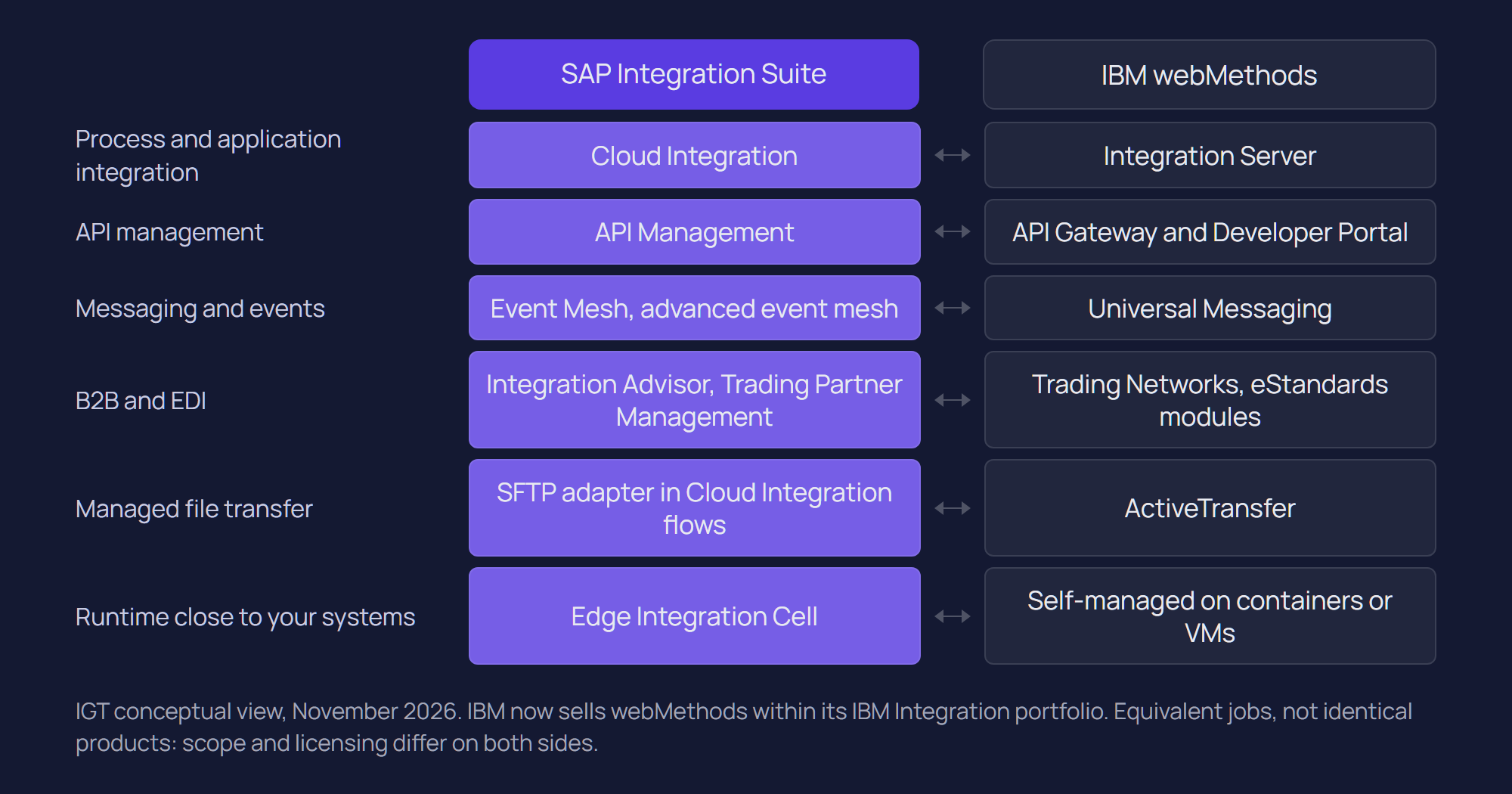
SAP Integration Suite is SAP's integration platform as a service, provisioned on SAP BTP with an optional hybrid runtime. IBM webMethods is a family of integration products that IBM now offers within its IBM Integration portfolio, deployable as IBM-managed SaaS or as self-managed software.
SAP Integration Suite
Integration Suite runs on SAP BTP in the Cloud Foundry environment. Its capabilities include Cloud Integration (formerly CPI), API Management, Event Mesh, Integration Advisor, Trading Partner Management, Integration Assessment and Migration Assessment. Our guide to SAP Integration Suite covers each one.
What matters here is where integrations execute. SAP documents two deployment models: cloud, where SAP fully manages the runtime on BTP, and hybrid, where Edge Integration Cell runs in your own Kubernetes cluster. In both, design and monitoring stay in the cloud. Edge Integration Cell needs supported Kubernetes plus an external database and data store for production, so it is real infrastructure to operate, not a lightweight agent.
IBM webMethods
IBM completed its acquisition of webMethods from Software AG on 1 July 2024. IBM now groups its integration products as IBM Integration, "formerly IBM webMethods Hybrid Integration and IBM Cloud Pak for Integration" in its own words. The webMethods-branded products within it are IBM webMethods Integration, IBM webMethods B2B and IBM webMethods MFT. Our primer What is webMethods? and our overview of the webMethods integration platform explain the basics.
Under those names, the components are familiar. Integration Server is the runtime that executes integration services. Universal Messaging is the messaging layer. Trading Networks manages B2B partners and documents. ActiveTransfer provides managed file transfer. webMethods API Gateway and Developer Portal handle API exposure and consumption. IBM made webMethods Integration 12.1 generally available in May 2026, with Java 21, Jakarta EE 10, container images and YAML-based runtime configuration.
On deployment, IBM offers IBM Integration as IBM-managed SaaS or as self-managed software on containers and virtual machines, with a hybrid control plane for visibility and lifecycle management across both. Many webMethods estates still run Integration Server on infrastructure the customer controls.
Need | SAP Integration Suite | IBM webMethods |
Application and process integration | Cloud Integration | Integration Server (IBM webMethods Integration) |
On-premise or private runtime | Edge Integration Cell (Kubernetes) | Self-managed Integration Server on VMs or containers |
API management | API Management | webMethods API Gateway and Developer Portal |
Messaging and events | Event Mesh, advanced event mesh | Universal Messaging |
B2B and EDI | Integration Advisor, Trading Partner Management, Cloud Integration runtime | Trading Networks with eStandards modules (IBM webMethods B2B) |
Managed file transfer | No dedicated capability; SFTP and FTP adapters | ActiveTransfer (IBM webMethods MFT) |
Migration from SAP PI/PO | Migration Assessment, Migration Tooling | No SAP-provided tooling; manual redesign |
One naming caution: IBM's 2026 portfolio also includes IBM API Connect and DataPower for API management, and IBM documents webMethods API Gateway within the API Connect documentation. Confirm which IBM API products your agreement covers.
How do they compare on SAP connectivity?
Integration Suite has the deeper native knowledge of SAP applications, especially for SAP cloud products and S/4HANA released APIs. webMethods has a mature SAP adapter that speaks the classic on-premise protocols (RFC, IDoc, BAPI) natively and runs wherever Integration Server runs.
Integration Suite and SAP
Integration Suite's main SAP advantage is content. SAP publishes prebuilt integration packages and API definitions on the SAP Business Accelerator Hub, maintained by their content owners, and SAP's own migration guide notes that messages processed by standard, unedited content for SAP-to-SAP integration are free of charge. For S/4HANA connecting to other SAP cloud applications, that combination is difficult for a third-party platform to match.
The protocol picture is more nuanced than "SAP knows SAP". According to SAP's PI/PO migration guide, Cloud Integration supports IDoc over HTTP, so classic IDoc packing over RFC cannot be used. The RFC receiver is available, but the RFC sender is only available on Edge Integration Cell. For S/4HANA Cloud Public Edition, integration runs mainly through released APIs (OData and SOAP) and business events, which applies to every middleware platform equally. See our article on clean core integration.
webMethods and SAP
webMethods connects to SAP through the webMethods Adapter for SAP, which runs on Integration Server. IBM's documentation for the SaaS SAP ERP connector, which is based on the same adapter (WmSAP), lists synchronous and asynchronous communication through RFC, tRFC, qRFC and bgRFC, higher-level services for IDocs and BAPIs, and ALE services. For ECC or on-premise S/4HANA, that is a direct protocol-level connection with no cloud hop.
What webMethods lacks is SAP's prebuilt business content: mappings are designed by your team or partner, and scenarios SAP ships as standard packages have to be built. webMethods can call S/4HANA's released OData and SOAP APIs like any HTTP endpoint, so clean core is a discipline it can follow.
What a real SAP ECC and MES project shows
IGT's One SAP, Five Factories case study was delivered on webMethods Integration Server, not on Integration Suite. A single SAP ECC core serves five factories in Belgium, Switzerland, China, Turkey and the United States. Integration Server consumes SAP IDocs, transforms them into a canonical XML model and routes them by configuration to TRAKSYS or PREACTOR, depending on which MES the plant runs. ActiveTransfer handles file-based document exchange, and monitoring, retry and replay are built in.
The result is 41 integration points and zero per-plant code forks: a new plant is a configuration entry, not a development project. It shows webMethods doing work SAP-centric architects sometimes assume needs an SAP tool, and that the decisive choices (canonical model, configuration-driven routing, operational tooling from day one) were architecture decisions rather than product features.
Which platform handles non-SAP and hybrid landscapes better?
For estates where SAP is one system among many, and much of the traffic never leaves the data centre or the plant, webMethods usually has the edge. Integration Suite can handle these landscapes too, but its strongest arguments are SAP-related, and its on-premise story depends on running Edge Integration Cell.
Picture a European manufacturer: an SAP core, several MES products, warehouse and transport systems, a legacy finance platform, SaaS tools and shared databases. Much of that traffic is ground to ground. webMethods began as on-premise middleware and still deploys naturally next to those systems. Our overview of what integrates with webMethods covers the range.
Integration Suite answers the same need with hybrid deployment through Edge Integration Cell. SAP positions it for scenarios that need low latency to factory systems, data residency, resilience against unstable connectivity and keeping sensitive systems unexposed, and it can keep processing messages without internet for a limited period. For SAP-centric flows, that keeps design, deployment and monitoring in one service.
The practical differences are operational:
- Infrastructure. Edge Integration Cell requires a supported Kubernetes cluster and the surrounding database and data store. Self-managed Integration Server runs on virtual machines or containers, a lower bar for teams without Kubernetes.
- Control plane. With Edge Integration Cell, design and monitoring stay in SAP's cloud. Self-managed webMethods can sit entirely inside your network, or connect to IBM's hybrid control plane.
- Connectivity breadth. Cloud Integration's adapter set is broad and growing, but some PI/PO-era adapters are still listed as "planned for future" in SAP's migration guide, including X400, RNIF and the OFTP receiver.
None of this makes Integration Suite unsuitable for non-SAP work; in many SAP-heavy estates it handles SaaS, CRM and logistics integration well. But the further SAP moves from the centre, the fewer of its distinctive advantages apply. For runtime options, see SAP Integration Suite architecture.
How do API management and events compare?
Both platforms cover API management and messaging. SAP's strengths are SAP-aware APIs and SAP business events; webMethods' strengths are a gateway and messaging layer that sit beside self-managed runtimes.
API management
SAP API Management handles exposure, security policies, versioning, analytics and a developer portal for consumers, and it can run API proxies on Edge Integration Cell. It is especially convenient for SAP OData and SOAP services already described on the Business Accelerator Hub. We cover it in SAP API Management.
webMethods API Gateway does the equivalent job: it lets an organisation expose APIs securely to developers, partners and other consumers, with the Developer Portal for discovery. It supports REST, SOAP, WebSocket, OData and GraphQL APIs according to IBM's documentation. Where APIs front services on Integration Server, keeping the gateway in the same platform reduces moving parts.
Events and messaging
On the SAP side, the Event Mesh capability of Integration Suite is a single broker intended for low and moderate event volumes, supporting AMQP, MQTT and HTTP with a 1 MB message size limit. SAP Integration Suite, advanced event mesh is the distributed, multi-broker option for higher volumes and larger messages, and outside the Enhanced Edition it is licensed separately. The main reason to choose SAP's eventing is SAP's own business events, which S/4HANA publishes through its event channels. Our article on SAP Event Mesh explains the options.
On the webMethods side, Universal Messaging provides publish and subscribe channels, queues, durable subscriptions, clustering and a JMS provider, and supports AMQP and MQTT. It carries whatever your integrations publish; it is not a source of SAP business events.
A useful rule: events that originate in SAP and serve SAP-adjacent consumers belong in SAP's eventing; integration-internal messaging (decoupling flows, buffering plant traffic) fits Universal Messaging. For the broader choice, see SAP integration patterns.
Which is better for B2B and EDI?
webMethods has the longer B2B track record and, today, broader protocol and standards coverage through Trading Networks and the eStandards modules. Integration Suite is solid for SAP-centric partner integration, especially X12 and EDIFACT into S/4HANA, but some protocols and editing tasks still need workarounds.
In Integration Suite, B2B is split between design time and runtime. Integration Advisor produces message implementation and mapping guidelines; Trading Partner Management holds partner profiles and agreements and generates runtime configuration; Cloud Integration processes the messages, with AS2, AS4 and SFTP adapters and EDI splitter and validator steps. Two documented gaps are worth knowing: there is no editor in Integration Suite for maintaining extended standard EDI messages, and several B2B protocols (X400, RNIF, CIDX, EBICS and the OFTP receiver) are still listed as planned, with OFTP sending possible only through an external bridge application.
In webMethods, Trading Networks manages partner profiles, document types and processing rules on Integration Server. eStandards modules add standards support, for example the RosettaNet module, which supports RNIF 1.1 and 2.0, alongside EDI standards such as ANSI X12 and UN/EDIFACT. Trading Networks can also deliver documents into ActiveTransfer's virtual folders, so partner file exchange and EDI processing share one platform. See our guide to webMethods B2B.
IGT's view: for X12 or EDIFACT partners over AS2 or SFTP feeding S/4HANA, Integration Suite is a reasonable default. For RosettaNet (via the RosettaNet module), heavy managed file transfer or many protocol variants, webMethods is often the stronger fit today.
How do development, operations and skills compare?
Both are graphical, model-driven environments with scripting for edge cases, but they differ in how they are built and run. The deciding factor is often the people you have and can hire.
Development model
Cloud Integration flows are designed in a browser-based editor, with Groovy or JavaScript for custom logic and message mappings for transformations. Prebuilt SAP packages can be extended rather than copied. Our article on SAP Cloud Integration covers the build experience.
webMethods development centres on Integration Server packages built with webMethods Designer: flow services, Java services where needed, adapters and document types. The 12.1 container images and YAML runtime configuration suit pipeline-driven deployment. Both platforms support CI/CD; your existing toolchain may favour one.
Operations and monitoring
With Integration Suite in the cloud, SAP operates the runtime, removing patching and capacity work. The trade-off is fewer low-level monitors than PI/PO offered and no built-in alerting out of the box: SAP's migration guide points to SAP Alert Notification service, SAP Cloud ALM or Solution Manager for alerts. With Edge Integration Cell, you also take on the Kubernetes layer.
With self-managed webMethods, your team or partner runs installation, fixes, high availability and capacity, in exchange for full control; in the factory case study, monitoring, retry and replay were built in so support did not need a developer every time a transaction needed attention. IBM-managed SaaS shifts that burden back to IBM.
Skills
Integration Suite skills often grow out of SAP PI/PO teams. webMethods skills sit with organisations and partners that have run the platform for years, and are rarer in SAP-only teams. Often the existing team's depth outweighs any feature: a well-run webMethods platform should not be replaced just because the ERP changes, and a strong SAP integration team should not be pushed onto webMethods without reason.
What commercial and strategic factors matter?
Both vendors license on usage or entitlement principles, and both have strategic reasons to keep you on their platform. Any real comparison needs quotes for your own volumes.
Integration Suite is sold under subscription editions and under SAP BTP consumption models (BTPEA, CPEA and pay-as-you-go), with message volume as the core metric. Edge Integration Cell runtime nodes and messages are counted under their own rules. Standard, unedited SAP content for SAP-to-SAP integration is not charged per message, which favours estates that can use SAP's packages as they are. Check the current terms in SAP Note 2903776 and with your account executive, because editions and metrics have changed over time.
IBM licenses its integration SaaS on usage-based credits and its self-managed software on entitlement-based licensing, according to its IBM Integration product page. If you already hold webMethods entitlements, the real question is whether running two platforms is justified.
Strategy matters as much as price. SAP names Integration Suite as its strategic integration platform and the target for PI/PO, ties it to BTP and clean core, and offers migration programmes and incentives for customers moving to it. IBM continues to invest in webMethods, as the 12.1 release shows. Neither platform is a dead end; the real risk is two platforms growing without a boundary.
Decision matrix: which platform fits?
The matrix below is IGT's working view, not a vendor standard. It describes the platform we would usually start from for each situation; a strong reason in your landscape can override any row.
Situation | Usually fits better | Why |
SAP S/4HANA plus SAP cloud applications at the centre | SAP Integration Suite | Prebuilt content, SAP-aware APIs and events, favourable metering for standard SAP-to-SAP content |
Clean core programme built on released APIs and SAP business events | SAP Integration Suite | Closest alignment with SAP's tooling and guidance; webMethods can follow the same discipline |
PI/PO replacement with mainly SAP-centric interfaces | SAP Integration Suite | SAP's Migration Assessment and Migration Tooling target it; Edge Integration Cell covers ground to ground |
SAP is one system among many, heavy non-SAP traffic | webMethods | Broad on-premise connectivity and no dependency on SAP's cloud for design or monitoring |
Mostly on-premise or plant-floor traffic, no Kubernetes platform | webMethods | Self-managed Integration Server on VMs or containers; Edge Integration Cell needs Kubernetes |
Large, healthy webMethods estate and team | webMethods | Replacing a working platform rarely pays back on its own; extend it to S/4HANA |
Complex B2B (RosettaNet, many protocols) or heavy managed file transfer | webMethods | Trading Networks, eStandards modules and ActiveTransfer on one platform |
X12 or EDIFACT partners feeding S/4HANA over AS2 or SFTP | Either; often Integration Suite | Trading Partner Management and Integration Advisor fit well when SAP is the target |
SAP-centric core plus heterogeneous plants, partners and files | Both | Split by workload: SAP flows on Integration Suite, heterogeneous and B2B traffic on webMethods |
When does running both make sense?
Running both makes sense when each platform does work the other would do less well, and the boundary between them is simple enough to explain to a new architect in one sentence. A common version: "SAP-to-SAP and SAP-to-SaaS integration runs on Integration Suite; plant, legacy, partner and file traffic runs on webMethods, which calls S/4HANA through released APIs or the SAP adapter."
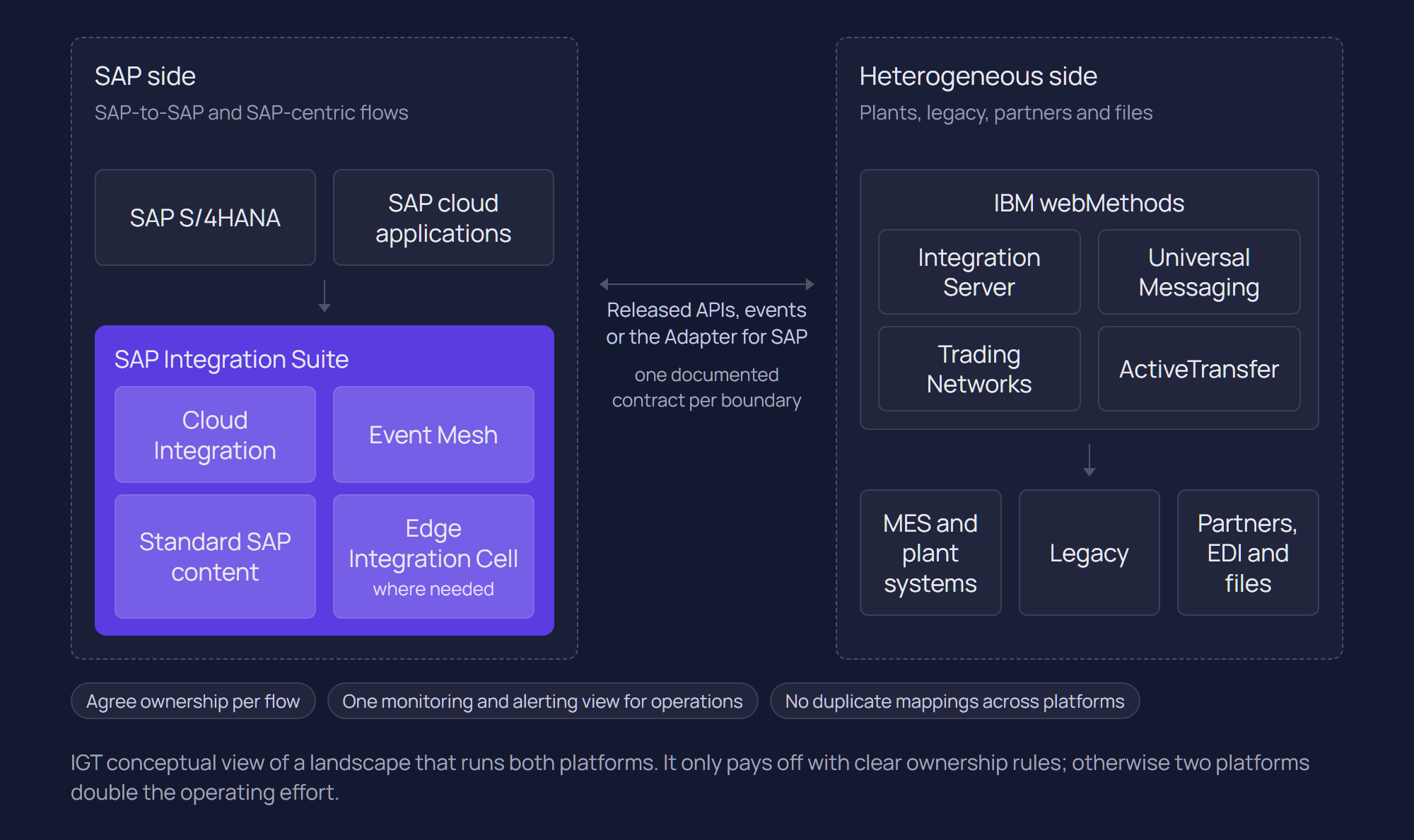
A split by workload characteristic tends to hold. A split by whichever team moved first does not: it produces duplicated connectors and no clear owner when a transaction fails between platforms. If you run both, agree on canonical data models, a shared approach to error handling and replay, and one place where end-to-end business monitoring lives.
Replacing SAP PI/PO: Integration Suite or webMethods?
For most PI/PO estates whose interfaces are predominantly SAP-centric, Integration Suite is the more natural target, because SAP's migration tooling, guidance and incentives all point there. webMethods becomes a serious option when PI/PO is mostly carrying non-SAP traffic, or when a strong webMethods platform already exists and can absorb the interfaces.
The timeline is the same either way. Mainstream maintenance for SAP Process Orchestration 7.5 runs through 31 December 2027 and optional paid extended maintenance through 31 December 2030. As SAP's CTO set out in October 2026, SAP NetWeaver AS Java 7.5 then moves into customer-specific maintenance from 2031 without a follow-on release. We cover what that means in SAP PI/PO end of maintenance.
SAP's Migration Guide for SAP Process Orchestration treats Integration Suite as the primary platform and Edge Integration Cell as the way to run cloud-designed content on-premise. Migration Assessment estimates technical migration effort, and Migration Tooling in Cloud Integration converts supported objects. None of that tooling targets webMethods, so a move from PI/PO to webMethods is a redesign project, sized by your own analysis.
That is not automatically a disadvantage: many PI/PO interfaces deserve redesign anyway, and a mature webMethods practice may find consolidation simpler than standing up a second platform. The deciding question is where the interfaces point. Our PI/PO migration guide and the comparison of SAP PI/PO vs Integration Suite go further.
Conclusion
SAP Integration Suite and IBM webMethods are both capable enterprise integration platforms, and neither is the right answer everywhere. Integration Suite is strongest where SAP is the centre: prebuilt content, released APIs, SAP events, PI/PO tooling and a clear place in SAP's strategy. webMethods is strongest where SAP is one important system among many: on-premise and plant-floor connectivity, mature B2B and managed file transfer, and full control of the runtime.
Most real decisions come down to three questions. Where do your interfaces start and end? Where must the integration logic physically run? And which platform does your team already operate well? Where the answers point both ways, a deliberate split with a one-sentence boundary is a sound architecture, not a compromise.
Because we deliver both, we can run that assessment without a stake in the outcome. If you are choosing between them, or planning how they should coexist, talk to our SAP integration and webMethods integration teams, or get in touch directly.
Related questions
Is webMethods an SAP product?
No. webMethods is an IBM product. IBM acquired it from Software AG in July 2024 and now offers it within its IBM Integration portfolio, while SAP's own integration platform is SAP Integration Suite on SAP BTP.
Can webMethods connect to SAP S/4HANA?
Yes. The webMethods Adapter for SAP supports RFC, BAPI and IDoc communication with on-premise and private cloud SAP systems, and webMethods can call S/4HANA's released OData and SOAP APIs over HTTP. For S/4HANA Cloud Public Edition, released APIs and events are the integration route for every platform.
Should we replace SAP PI/PO with webMethods or SAP Integration Suite?
If most interfaces start or end in SAP, Integration Suite is usually the more natural target, because SAP's migration tooling and content support it. If PI/PO mainly carries non-SAP traffic, or a mature webMethods platform already exists, consolidating onto webMethods can be the simpler path, but it is a redesign rather than a tool-assisted migration.
Can SAP Integration Suite and webMethods run together?
Yes, and in many SAP-centric but heterogeneous estates that is a sound design. It works when the boundary is clear, for example SAP-centric flows on Integration Suite and plant, partner and file traffic on webMethods, and when both share data models, error handling and end-to-end monitoring.
Which is better for B2B EDI: webMethods or SAP Integration Suite?
For X12 or EDIFACT partners feeding S/4HANA over AS2 or SFTP, both can do the job, and Integration Suite fits well when SAP is the target. For RosettaNet, protocols SAP still lists as planned, or B2B combined with heavy managed file transfer, webMethods with Trading Networks and ActiveTransfer is often the stronger fit.
Sources
IBM: IBM Integration (formerly IBM webMethods Hybrid Integration and IBM Cloud Pak for Integration)
IBM Support: IBM webMethods Integration 12.1
IBM: IBM webMethods Hybrid Integration, from connectivity to control in the AI era (1 July 2026)
IBM Newsroom: IBM Completes Acquisition of StreamSets and webMethods (1 July 2024)
IBM Documentation: SAP ERP connector, IBM webMethods Integration (SaaS)
IBM Documentation: Adapter for SAP, IBM webMethods Adapters
IBM Documentation: Working with IBM webMethods Integration Server 12.1
IBM Documentation: IBM webMethods Universal Messaging 12.1
IBM Documentation: Understanding IBM webMethods B2B Trading Networks
IBM Documentation: webMethods Module for RosettaNet
IBM Documentation: Using webMethods API Gateway, IBM API Connect
SAP Help Portal (SAP-docs mirror): Deployment Options and Runtimes, SAP Integration Suite
SAP Help Portal (SAP-docs mirror): What is SAP Integration Suite?
SAP Migration Guide for SAP Process Orchestration (SAP-docs mirror): Standard Adapter Migration
Latest writings
The latest news, technologies, and resources from our team.
View all blogs

Let’s make it click!
Whether you're scaling a startup or streamlining a corporate ecosystem, we help teams launch faster and integrate smarter.

Eva Polcíková
Project Manager