SAP PI/PO End of Maintenance: What 2027 and 2030 Really Mean, and Your Options
PI/PO does not switch off in 2027. But extended maintenance is paid, there is no follow-on release, and after 2030 SAP will not fully support Java or the database. What each date means in operation, the real options, and how to plan backwards.

Last technically reviewed: 09/11/2026. Reviewed by Marek Juračka, CTO.

Table of contents
SAP PI/PO end of maintenance is no longer a line on a distant roadmap slide. Mainstream maintenance for SAP Process Orchestration 7.5 and SAP Process Integration 7.5 ends on 31 December 2027, optional extended maintenance runs to 31 December 2030, and in October 2026 SAP spelled out what happens after that. The question for a head of integration has moved from "when" to "what does each date mean for the platform that carries our orders, invoices and shop-floor confirmations".
None of these dates switches PI/PO off. What changes is what SAP will fix, patch and support, and that matters for security, for the operating system, database and Java underneath, and for anyone who has to confirm that business-critical systems are supported.
This article explains what each date means in operation, corrects common misconceptions, compares the realistic options and shows how to plan backwards from the deadline. The migration method itself is covered in our SAP PI/PO migration guide.
In short
Mainstream maintenance for PI/PO 7.5 ends on 31 December 2027, and paid, optional extended maintenance runs to 31 December 2030; releases 7.4 and older left mainstream maintenance at the end of 2020 with no extended option.
From 2031, PI/PO 7.5 is in customer-specific maintenance with no follow-on release, and SAP has said it will not be able to provide comprehensive support for Java or database-related issues.
SAP names SAP Integration Suite, with Edge Integration Cell for on-premise runtimes, as the path forward, so the real decisions are about timing, target platform and how to bridge the gap.
When does SAP PI/PO maintenance end?
Mainstream maintenance for SAP PI/PO 7.5 ends on 31 December 2027. Optional extended maintenance is available from 1 January 2028 to 31 December 2030, and from 2031 the release is in customer-specific maintenance without a follow-on release.
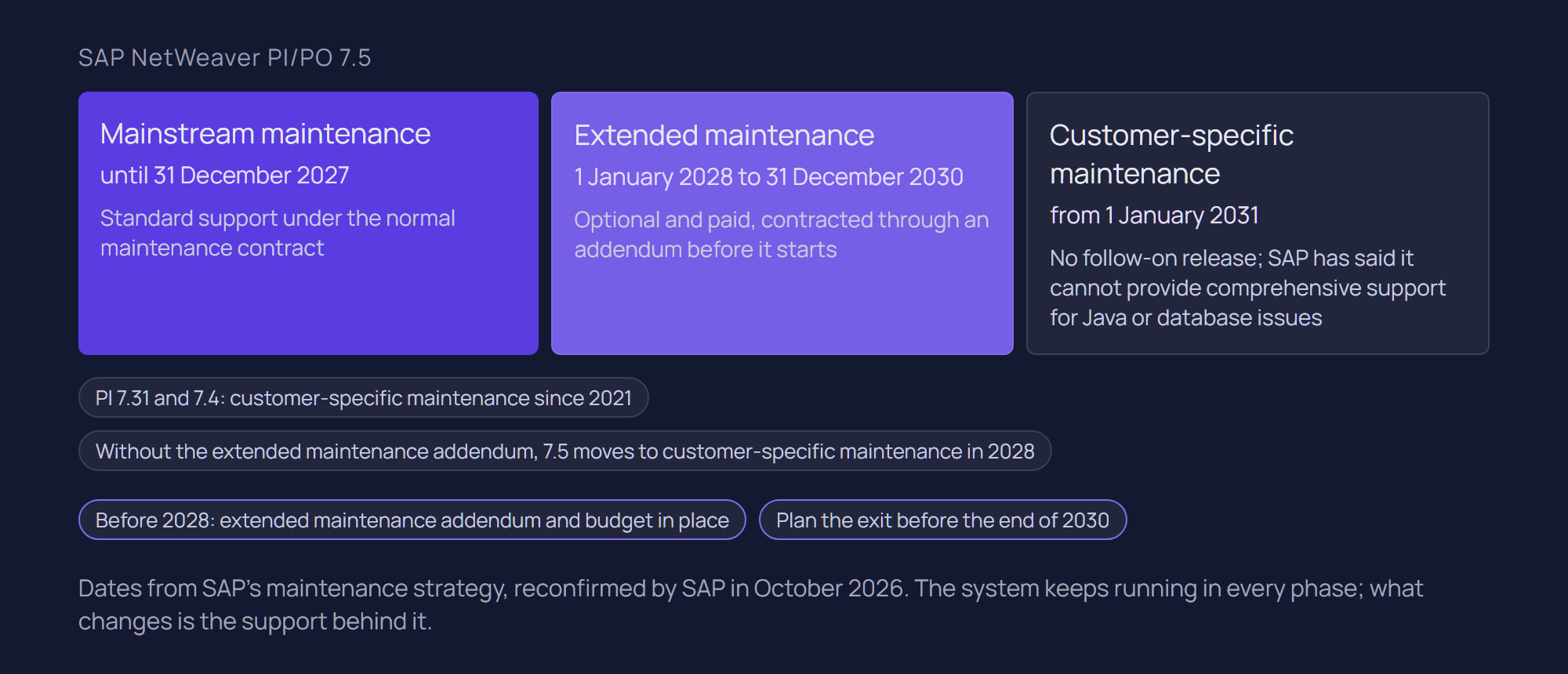
The dates go back to 2020, when SAP aligned SAP NetWeaver 7.5, and with it PI and PO 7.5, with SAP Business Suite 7, as set out in the SAP NetWeaver 7.5 maintenance strategy. In October 2026, SAP restated them for PI/PO customers in a post on the 2030 timeline, and SAP's CTO confirmed on SAP News that the dates announced in 2020 remain in place.
Period | What SAP provides for PI/PO 7.5 | Cost on top of your maintenance fee |
Until 31 December 2027 | Mainstream maintenance, including new support packages | None |
2028 to 2030, with extended maintenance | Extended maintenance, with a scope of support similar to mainstream | An additional fee and a maintenance addendum; SAP's 2020 terms set a premium of two percentage points on the existing maintenance basis |
From 2028, without extended maintenance | Customer-specific maintenance: no new support packages, no legal-change updates, limited technology updates, and fixes for problems not yet known to SAP are charged | No addendum; the release enters this phase automatically |
From 1 January 2031 | Customer-specific maintenance with no follow-on release and no comprehensive support for Java or database-related issues | Fixes for new problems are charged |
The phase definitions come from SAP's Release and Maintenance Strategy. The binding scope of customer-specific maintenance is in SAP Note 52505.
What about PI 7.31 and 7.4?
Releases 7.4, 7.3, 7.31 and 7.1x left mainstream maintenance at the end of 2020, and SAP did not offer extended maintenance for them. Under SAP's maintenance strategy, such releases move into customer-specific maintenance automatically, so these systems have been there since 2021. They can still be a migration source: Migration Assessment and the migration tooling accept 7.31 SP28 and 7.40 SP23 and above.
Add-ons and the private cloud edition
In 2020, SAP extended the maintenance of the PI B2B add-on, connectivity add-on and secure connectivity add-on in line with release 7.5. For SAP Process Orchestration, private cloud edition, maintenance ends on 31 December 2030, as SAP has communicated with reference to SAP Note 3833114.
What actually changes after 2027?
After 31 December 2027, PI/PO 7.5 keeps running, but your support position depends on whether you sign an extended maintenance addendum. With it, support continues at a scope similar to mainstream for an additional fee. Without it, the system moves into customer-specific maintenance.
Extended maintenance is paid and has to be contracted
Extended maintenance is neither free nor automatic: SAP's maintenance strategy requires an additional payment and a specific addendum based on a valid maintenance contract. On price, SAP's February 2020 announcement set the premium for SAP Business Suite 7 at two percentage points on the existing maintenance basis, and the NetWeaver maintenance strategy states that NetWeaver 7.5, including PI/PO 7.5, follows the same price and conditions. What that means in money depends on your contract, so ask your SAP account team.
Why "it will not switch off" does not mean "no risk"
A platform that keeps running is not the same as a platform that stays supportable. Three things change.
Corrections and patches. In customer-specific maintenance there are no new support packages, and resolving a problem SAP does not yet know about becomes a chargeable, customer-specific service. Check with SAP what this means for security corrections, because SAP Note 52505 defines the scope.
Operating system, database and Java. SAP notes that NetWeaver maintenance timeframes are much longer than those of the underlying databases and operating systems, and it qualifies new combinations with platform partners in the Product Availability Matrix. PI/PO 7.5 runs on AS Java 7.5 with SAP JVM 8, and SAP's support arrangements for that Java end at the end of 2030.
Audit and assurance. In many organisations, internal IT policies, external auditors or insurers ask whether business-critical systems run on vendor-supported software. Extended and customer-specific maintenance may be judged differently, so check what your own policies require.
What happens after 2030?
From 1 January 2031, PI/PO 7.5 is in customer-specific maintenance with no follow-on release. In October 2026, SAP added that because its support arrangements for the Java used with NetWeaver AS Java 7.5 expire at the end of 2030, it will not be able to provide comprehensive support for Java or database-related issues in these environments.
The SAP post for PI/PO customers draws the consequence and calls customer-specific maintenance "an unsustainable long-term model" for business-critical integration infrastructure. The constraint applies whether or not you still run SAP Business Suite 7, because PI/PO depends on AS Java 7.5 in its own right.
The SAP News article by Philipp Herzig adds the database side: for systems on third-party databases, SAP will no longer cover today's database-related corrections, including for customers who licensed the database through SAP. SAP Note 3464370 lists SAP's proposed transitions for NetWeaver AS Java.
Why this matters most in regulated industries
For banks, insurers, pharmaceutical manufacturers, utilities and the public sector, the post-2030 position is particularly hard to defend. A platform with no follow-on release and no comprehensive Java or database support is difficult to present as a controlled risk, so the end of 2030 is better treated as the latest possible exit than as the plan.
Common misconceptions about PI/PO end of maintenance
"PI/PO stops working in 2027"
It does not. 2027 is the end of mainstream maintenance, not a shutdown, and messages will still flow on 1 January 2028. Anyone using an imminent shutdown to create urgency is overselling.
"We have until 2030, so nothing needs to happen yet"
Only if you pay for extended maintenance, and only if the migration is finished before the end of 2030. A programme still running in 2031 operates its remaining interfaces without comprehensive Java or database support. The date that matters is when you must start, not when support ends.
"Migration is just an upgrade"
There is no upgrade path. PO 7.5 has no follow-on release, and SAP Integration Suite is a different platform with a different design model, runtime and operating model. Some objects migrate with tooling and many need adjustment or redesign, as our comparison of SAP PI/PO and SAP Integration Suite shows component by component.
"SAP moved the dates in 2026"
It did not. The 2026 announcements concern what customer-specific maintenance can cover after 2030, not the calendar.
What are your options?
There are three realistic options, and large estates often combine them: bridge with extended maintenance while you migrate, move to SAP Integration Suite (including Edge Integration Cell for on-premise runtimes), or move some or all interfaces to another platform where the landscape is mostly non-SAP. Staying on PI/PO after 2030 remains technically possible, but SAP itself does not present it as sustainable.
Bridge with extended maintenance, and plan the exit
Extended maintenance buys time to the end of 2030 at a premium. For a large estate with a migration planned or under way, that is often a sensible bridge, as long as it has an exit date. Without one, the bridge becomes the destination, and the organisation reaches 2030 having paid the premium without shrinking the PI/PO footprint.
Migrate to SAP Integration Suite
SAP calls SAP Integration Suite its strategic integration platform and the path forward for PI/PO. SAP's Migration Guide for SAP Process Orchestration describes Integration Suite as the primary platform to which PI/PO interfaces are transitioned, through an assess, transform and move approach. For the destination itself, see what SAP Integration Suite is and how Cloud Integration runs integration flows.
This does not mean moving every message through the public cloud. Edge Integration Cell is an optional hybrid runtime: you design and monitor in the cloud, and deploy and run in your private landscape. SAP positions it explicitly as a migration path for PI customers with ground-to-ground scenarios. It runs on Kubernetes, which brings its own operations requirements. Where flows run in SAP's cloud and need to reach on-premise systems, SAP Cloud Connector provides the channel. Our article on SAP Integration Suite architecture explains how the runtimes fit together.
Move to another platform where the landscape is mostly non-SAP
Some PI/PO installations carry little SAP traffic. They connect warehouse systems, partners, file transfers and legacy applications, with SAP as one endpoint among many. There, the end of maintenance is a fair moment to choose the platform on its merits rather than by default, and IBM webMethods is one reasonable alternative to evaluate alongside SAP Integration Suite. Our comparison of SAP Integration Suite and webMethods sets out where each fits.
The trade-off runs both ways. Integration Suite brings prebuilt SAP content and SAP's own migration tooling, which count for a lot in SAP-centric estates. Another platform can suit a heterogeneous estate better, but if SAP-to-SAP traffic remains, you may end up operating two platforms. IGT delivers on both SAP Integration Suite and webMethods, so we start from the estate, not the product.
Option | When it makes sense | Main risk |
Extended maintenance as a bridge | Large estate, migration planned or under way, exit date before the end of 2030 | The bridge becomes the destination and the premium buys no progress |
SAP Integration Suite, cloud runtime | SAP-centric landscape, S/4HANA or SAP cloud applications, growing SaaS footprint | Treating the move as a 1:1 conversion and carrying technical debt into the cloud |
SAP Integration Suite with Edge Integration Cell | Ground-to-ground scenarios, data that must stay on-premise, low-latency links to plants | Kubernetes skills and infrastructure must be in place |
Another platform, such as webMethods | Mostly non-SAP landscape, heavy B2B or file traffic, existing investment in that platform | Losing SAP prebuilt content and tooling, or running two platforms if SAP traffic remains |
Stay on PI/PO after 2030 | Hard to justify for business-critical traffic | No follow-on release, chargeable fixes, no comprehensive Java or database support |
How to plan backwards from the deadline
Start from the date by which PI/PO must be switched off, then work backwards through decommissioning, testing, migration waves, target design and assessment. The latest realistic exit is the end of 2030; it comes earlier if you decide against extended maintenance or if an S/4HANA programme or data centre exit sets its own date.
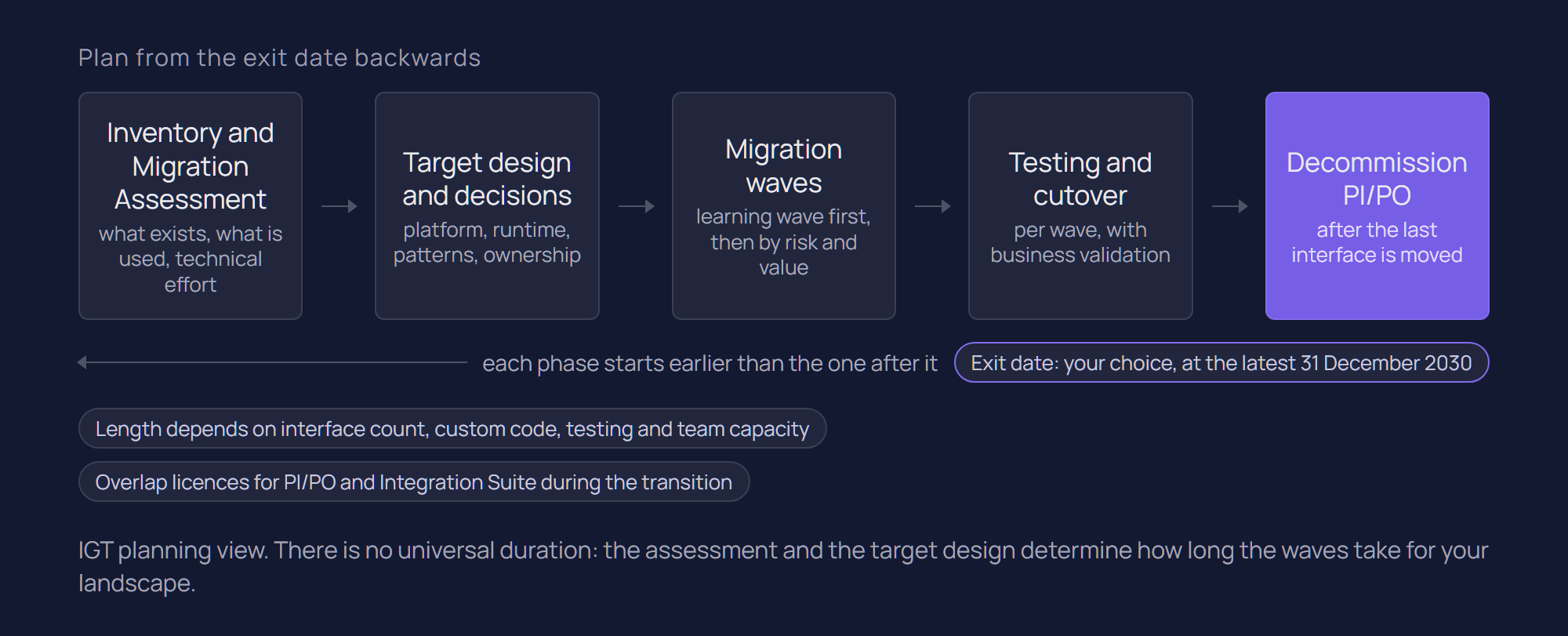
Start with an inventory and Migration Assessment
SAP's Migration Assessment capability extracts data from a PO system (7.31 SP28, 7.40 SP23 or 7.50 SP06 and above), evaluates the scenarios and estimates the technical migration effort. It does not migrate anything; that is the job of Migration Tooling in Cloud Integration. Our article on SAP Migration Assessment explains what it covers and leaves out.
The tool output is a starting point, not a plan. Business owners, criticality, dependencies and the target architecture still have to be added, as described in our PI/PO migration roadmap. Separately, SAP offers a free advisory assessment through its Migration Factory programme, listed on the SAP Integration Suite migration page.
What determines the length of the programme
There is no honest universal duration. The length comes from the estate:
The number of interfaces and, more importantly, the spread of complexity across them
Custom code: Java mappings, adapter modules and custom adapters
BPM, ccBPM and B2B content, which usually needs redesign rather than conversion
Testing capacity and production-like test data
The share of interfaces redesigned as APIs or events rather than migrated
Business calendar windows when cutover is not allowed
Two estates with the same interface count can differ widely on all of these.
The budget window
Two budget questions arrive together. Extended maintenance starts on 1 January 2028, so the addendum and its budget have to be in place before then; ask your SAP account team for the contracting deadline, and expect it to fall in the next budget round. And during the migration you pay PI/PO maintenance, possibly with the premium, alongside an Integration Suite subscription or consumption.
SAP offers cloud credits as financial transformation incentives to offset dual-licence and migration costs, on terms agreed individually through your SAP account executive. Factor them in, but budget for the overlap as if they were not there.
What to tell management
Management needs the date, the risk and the next step. Three sentences cover it:
Our integration platform, SAP PI/PO 7.5, leaves mainstream maintenance on 31 December 2027, and paid extended maintenance can cover it until 31 December 2030, after which SAP offers no follow-on release and no comprehensive Java or database support.
The platform will not stop, but from 2028 we either pay a maintenance premium or run business-critical interfaces with reduced support, and after 2030 SAP itself does not consider continued operation sustainable.
We recommend funding an assessment of our interface estate now, so that we decide on extended maintenance and the target platform with real data before the 2028 budget is fixed.
If that assessment needs outside support, our SAP integration services cover inventory, Migration Assessment and target architecture.
Conclusion
The SAP PI/PO end of maintenance comes in stages: mainstream to the end of 2027, paid extended maintenance to the end of 2030, then customer-specific maintenance with no successor release. The platform keeps running throughout; the support underneath it thins out.
That makes this a planning question rather than an emergency. Measure the estate, decide whether you need extended maintenance as a bridge, choose the target platform on the merits of your landscape, and set an exit date that leaves room for testing and decommissioning before the end of 2030.
If you are working out what the PI/PO deadlines mean for your landscape, talk to our SAP integration team.
Related questions
Will SAP PI/PO stop working after 2027?
No. The end of 2027 is the end of mainstream maintenance, not a shutdown. What changes is the support SAP provides, and whether you pay for extended maintenance until the end of 2030.
How much does SAP PI/PO extended maintenance cost?
SAP's 2020 announcement set the premium at two percentage points on the existing maintenance basis, and SAP stated that PI/PO 7.5 follows the same price and conditions. It requires a maintenance addendum, and the actual amount depends on your contract, so confirm it with your SAP account team.
Is SAP PO 7.5 the last release?
Yes. SAP has stated that PI/PO 7.5 moves into customer-specific maintenance from 2031 without a follow-on release, so the way forward is a migration rather than an upgrade.
What is the official SAP replacement for PI/PO?
SAP Integration Suite, which SAP calls its strategic integration platform. For scenarios that must run on-premise, SAP points to Edge Integration Cell, which lets you design and monitor in the cloud while running integrations in your own landscape.
Can we stay on SAP PI/PO after 2030?
Technically yes, under customer-specific maintenance, which currently has no expiry date. But there are no new support packages, fixes for new problems are charged, and SAP will not be able to provide comprehensive Java or database support, so SAP does not consider it sustainable for business-critical integration.
Sources
SAP Community: SAP NetWeaver 7.5 Maintenance Strategy
SAP Support: Maintenance strategy
SAP Help Portal: What is SAP Integration Suite?
SAP Help Portal: What Is Edge Integration Cell
SAP-docs (GitHub): What Is Migration Assessment?
SAP-docs (GitHub): What Is Migration Tooling?
SAP: SAP Process Orchestration to SAP Integration Suite Migration
Latest writings
The latest news, technologies, and resources from our team.
View all blogs


Let’s make it click!
Whether you're scaling a startup or streamlining a corporate ecosystem, we help teams launch faster and integrate smarter.

Eva Polcíková
Project Manager